
Kakaw (Chocolate)
A highly valued trading commodity, and an elite beverage
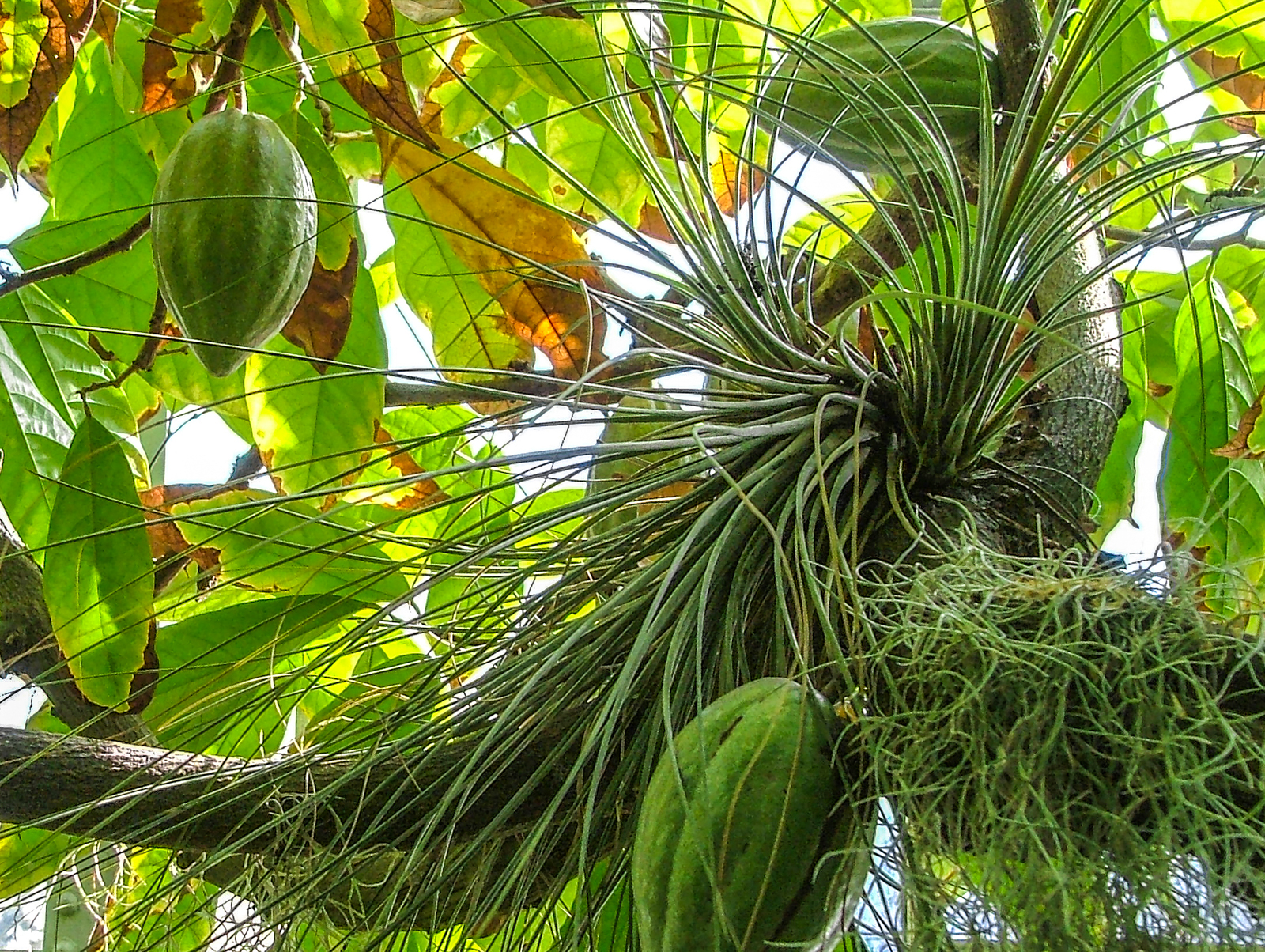
Kakaw trees can’t tolerate high altitudes or temperatures below 60º F. They need moisture year-round, so during prolonged dry seasons irrigation is necessary. Given these considerations, they were domesticated in the Pacific coastal plains of Guatemala and Chiapas around 1000 B.C., at the height of the Olmec civilization at San Lorenzo. The area around Izapa, a Late Formative site in Chiapas, was a particularly rich source of kakaw (cacao) because it was very hot with volcanic soil.
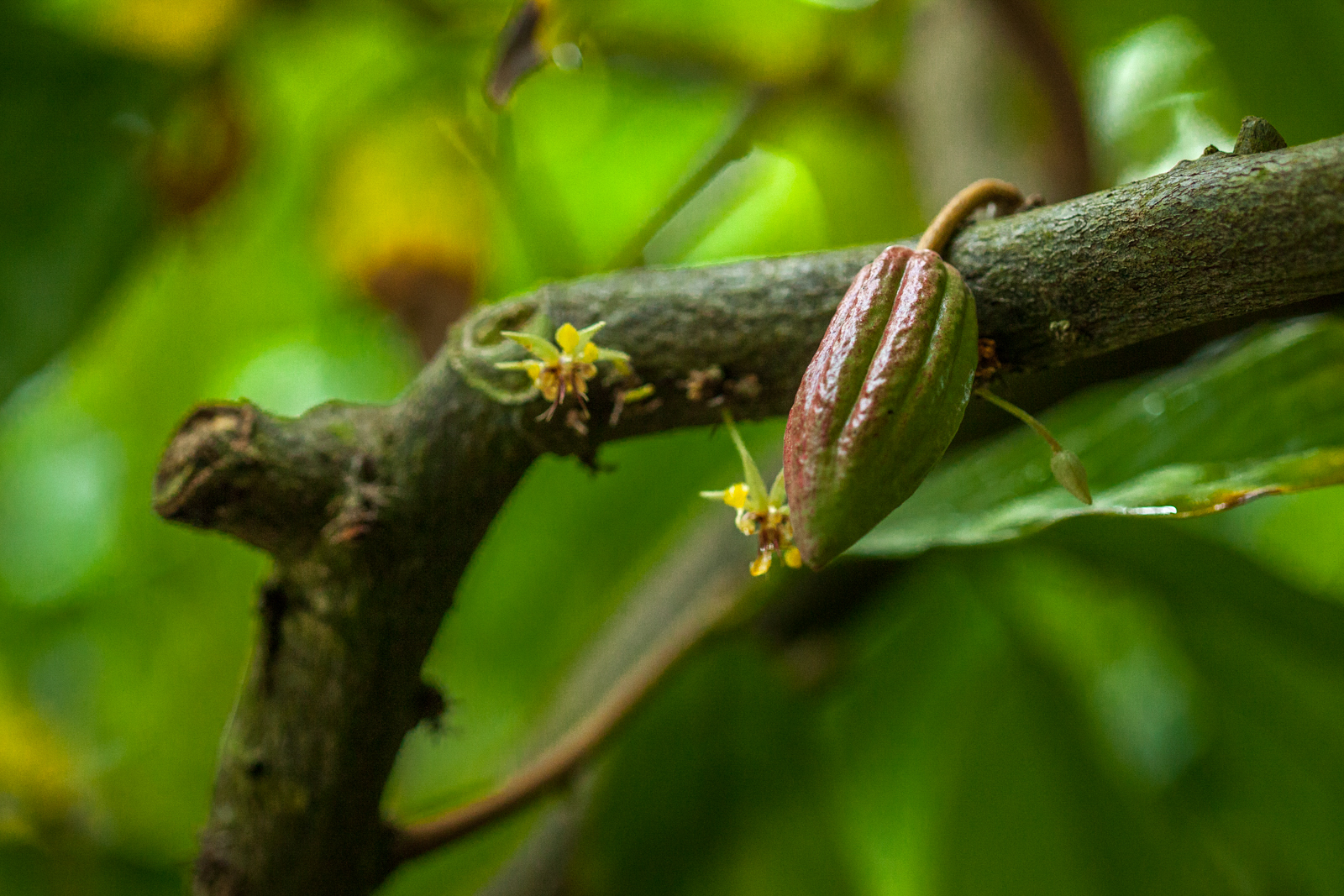
The variety of cacao grown in the Maya area is called theobroma bicolor—“pataxte” in Mayan. The tree’s flowers and fruits or pods grow directly on the trunk. Each fruit is around 11” long and 4” wide with an average weight of one pound. The color ranges from reddish to green, but it changes to yellowish orange as the fruit matures. The pods contain 20 to 40 beans enveloped in a sticky, white pulp. The beans are large and flat, and are sometimes eaten raw. Each tree will produce around 40 pods, yielding about 4.5 pounds of chocolate. It has been suggested that the name “chocolate” derives from the Mayan word chokola’j, “to drink cacao together.”
Mentioned frequently in the inscriptions as a trade good and an elite consumable, it seems kakaw was an array of beverages rather than a single drink. Beverages are described as “honeyed kakaw,” “flowered kakaw,” “bright red kakaw, “black kakaw,” “ripe kakaw,” “sweet kakaw,” and “frothy kakaw.” The ancients toasted the beans and used them to make gruels and porages. Additives could include honey, chile peppers, annatto (to make it red), fruit juices, flower blossoms and vanilla. And through fermentation, they produced a cacao flavored alcoholic beverage. Perhaps because kakaw concoctions were such an imported extravagance, some of the inscriptions specify the cities where and when they were served.

A palace scene from Dos Pilas, Guatemala shows a flower bouquet being presented to a seated lord. In front and below him is a platter of kakaw pods.
A study by Joanne Baron, published in Economic Anthropology, revealed that cacao beans, “originally valued for their use in status display, took on monetary functions within a context of expanding marketplaces among rival Maya kingdoms. These products would eventually go on to serve as universal currencies across the different Maya regions and were used to finance state activities as well as household needs. By the time the Spanish had arrived in the early 1500s, these (kakaw) products were being used to pay tribute or tax to leaders, to buy and sell goods at the marketplace or pay workers.”
The kakaw sacks shown in the Bonampak murals were labeled with the kakaw glyph surmounted by a number which David Stuart deciphered as 5 pik of forty thousand seeds. He also notes the frequent use of a 3 pik label—twenty-four thousand seeds—which coincides with a count of cacao seeds that was considered a “carga” in Postclassic highland Mexico.
At the time of the conquest, a “load” of kakaw—24,000 beans—was worth twice as much in Tenochtitlan as along the Gulf coast. A rabbit costs 10 beans, and a porter charged 20 beans for a short trip. A 1545 document written in Nahuatl states that a turkey was worth 200 cacao beans, a tamale worth one, and the daily wage of a porter at that time was 100 beans. It was also noted that dishonest traders made counterfeit beans by stripping the husks of the beans, filling them with sand, and mixing them with genuine beans. Careful customers squeezed each bean to test it.
Counting Kakaw Beans
Excerpt from Jaguar Rising (p. 205)
OUR EARLY TRAINING HAD TO DO WITH TRADING, TERRITORIES, the names of places, rulers, ministers and counting. We learned the value of goods, especially those desired by lords, noblemen and holy men. We learned hand signs, not only to trade and speak with foreigners but also to signal each other under conditions of scouting and attacking. We learned how to use vines, moss on the side of trees and the stars as directional pointers. Especially, we learned which goods would be traded in the various markets.
To learn how to show respect to power and speak in our trading partner’s favor, we put on hats and bargained with each other. Instead of using stones and sticks for counting, Pech taught us to use lucina shells for “zero,” kakaw beans for “one’s,” and flat hands for “five’s.” A hand covering our chins stood for “twenty.” In the counting trial, we had to place and call, sum and subtract numbers in orders of thousands because kakaw beans were traded in “loads”—cloth bundles of eight thousand, what one man could carry.
Kakaw Valuation
Excerpt from Jaguar Sun (p. 98)
BY THE THIRD DAY IN THE MARKETPLACE AT IXKUN, SO many warriors and farmers were coming to have me rework their cherts and flints, Eagle fixed the exchange at two, four or eight hundred kakaw beans depending on how long it took me to do the work. After another day, a line formed. I was spending nearly as much time counting kakaw and shell beads as I was shaping stone, so Eagle had one of the assistants do the counting for me. It felt good to be contributing to the expedition, but by the end of the day, the muscles in my chopping arm were chattering. And I was out of Strong Back. Darts came by several times and stopped to watch me work. Whenever I looked at him or nodded he turned away.
Checking For Counterfeit Beans
Excerpt from Jaguar Rising (p. 67)
In the days leading up to Grand Procession, the counters and court scribes examined every needle, bead, feather, hide and kakaw bean. Day and night, a band of guards walked the perimeter of the compound while others armed with spears, axes, knives and flint-tipped darts walked the patio. Two of them stationed at the stairway searched everyone who came and went, including those of us who lived on the compound.
Pouring Kakaw To Make Foam
Excerpt from Jaguar Wind and Waves (p. 67)
For the feast I had arranged for the ministers to sit on reed mats in a circle. Lime Sky and her assistants prepared maize leaf tamales, most stuffed with turkey, others with paca meat. Four of my serving women had never been to court before, so I worried that they would drop or spill something—or not understand a minister’s gesture. Along with the tamales we served roasted grubs with mashed beans and platters of cooked chayote greens topped with crumbled roasted squash seeds that she dusted with chili powder. For the beverage we served chih with lime juice and honey. The final offering, an extravagance usually reserved for lords and their ladies, was kakaw poured into tall cups from the height of the server’s breast to raise a dark brown foam.
(Photo of the palace scene courtesy of Justin Kerr “Maya Vase Database”)
____________________________________________________________________________
For a brief description of The Path Of The Jaguar novels: Go to the Home Page—Novels
Links To Amazon.com for paperback books and Kindle Editions
Jaguar Rising: A novel of the Preclassic Maya
Xibalba: The Place of Fright
The Maya underworld and the god of death
 Rollout vase photo courtesy of Justin Kerr
The Maya Underworld, called Xibalba (She-balba), “The Place of Fright,” was the realm beneath the surface of the Earth and under water, especially in caves. It was perceived to have nine descending levels arranged like an inverted pyramid, and was ruled by the Bolontik’u, “Nine Lords of Death” and was often depicted on vases as a giant conch or snail shell which enclosed a mysterious other reality interpreted by some to be an infinite, eternal and bloody ocean of bliss.
The Underworld was always pressing upward through portals—volcanoes, floods, and earthquakes—where the demons could emerge and work their dark magic. As entrances to the Underworld, caves were considered sacred and preferred locations for sacrificial offerings. There is no evidence to suggest that Xibalba was a kind of hell; the belief was that to die in one world was to be born into another.
The Lords Of Xibalba
According to the Popol Vuh, the K’iche’ Maya mythical “Book of Counsel,” the Lords of Xibalba possess three outstanding characteristics. In the first place, they were liars and tricksters. To trick the Hero Twins into playing a ball game, they said they admired their ability and the contest would be exciting. But it was just an enticement to kill them.
Secondly, the lords were stupid. In a second attempt to create human beings who would praise them and offer them their blood and sweat, they made them out of wood. There was nothing in these human’s equivalent to hearts or minds, and they had no memory. It was a failed attempt. Lastly, in several instances, the Underworld lords demonstrated cruelty and hardheartedness.
The Vase Shown Above
Above, center right, the Underworld Lord, known to scholars as “God A,” is shown dancing beside a witz “living mountain” throne, on top of which is an infant jaguar identified by its tail and paws. Art Historian Penny Janice Steinbach suggests that the infant with jaguar traits is being sacrificed as “part of a pre-accession ritual serving to endow royal heirs with the ability to conjure, which, in turn, was integral to assuming the throne.” To the right of God A is a dog, known to escort souls of the deceased across a river and into the Underworld.
Above him, is a fanciful firefly, perhaps there to illuminate the darkness of the watery world below. To the left of the spirit-spewing mountain, the rain god Chaak dances, holding aloft a hand-stone typical of those used in certain ball games and boxing matches. In his other hand, he wields an axe with which he creates lightning and thunder. Typical of Maya art, the image is filled with symbolism, glyphs and mythical references. Every element has meaning.
God A — Cizin “Farter.”
God A is a death god. He’s a skeleton figure with a distended abdomen, pronounced spinal column, truncated nose and grinning teeth. And he emits a stench, possibly that of dead bodies. He wears bell-bracelets on his hands and feet, a decapitation collar, and he has disembodied “death eyes” with the nerve stalks attached. His body is sometimes marked with “death spots,” which is a sign of decomposition. And he can be seen sitting on a throne of bones. Unlike the dance of rulers, his dance above is wild and undignified. His skeletal countenance is that of a trickster, typical for an Underworld deity.
Jaguar Rising — The Novel
The first initiation trial for One Maize to become a “man of the community” was to capture, not kill, a deer and bring it into his father’s pen alive. Here, the second of three trials is a drug-induced journey into the Underworld to see if he can hold his own with one of the Lords of Death.
Journey Into The Underworld
Excerpt From Jaguar Rising (pp. 121-123 )
Inside the temple, White Grandfather set the torch in a holder on the wall and tied back the doorway drape a little to remove the thin veil of ash that lingered in the air. Following his gesture I sat on an ocelot pelt with my back against a side wall. Painted black on the wall across from me was a medallion, a large circle with inset corners that framed the cross-eyed, shark-tooth face of Lord K’in. Taking fire from the torch with an ocoté stick, he lit some tinder in a censer. When it flamed, he added the stick and three others before setting it in front of me. He took a blue-painted calabash from under the medallion and nodded for me to take one of the many rolled-up leaves it contained. Inside the leaf was a cigar. “We wrap them with bits of copal bark,” he said, and scrapings from the backs of frogs.” It releases the ch’ulel to go through the portal.”
Sitting next to me, White Grandfather removed his headgear and re-tied the three-leaf headband so it fit snug on his forehead. After adding another stick and some copal nuggets to the censer, its sweet smoke replaced the acrid smell of burnt ash, and it wafted to a hole high in the back wall. As my eyes became accustomed to the dark, I noticed a round feather-standard leaning against the wall next to the doorway. Tied to crossed lances in front of it was a ceremonial shield with the face of a laughing falcon on it. Beside me, arranged on a reed-mat, were ceramic cups, an incense bag and an offering bowl containing strips of cotton and square leaf-packets that were tied with string and painted red. Next to my teacher was a bundle of ocoté sticks, an incense bag, a carapace drum, rattle, grinding stone and two gourds with stoppers.
White Grandfather took one of the burning sticks from the censer and lit a cigar. “This is the holy portal,” he said, puffing to get it lit. He handed it to me and told me to take several strong puffs, each time breathing it in. I’d smoked cigars with Thunder Flute and my uncles before, even inhaled, but this was very different. It was thick and tasted like a combination of tree sap and burnt thatch. The smoke stung my nose and bit my tongue. White Grandfather set the drum, rattle and incense bag in front of him. “Keep breathing it in, grandson.” I did, but I kept coughing. “Blow some smoke to the medallion,” he said pointing. “That is the place of entry, the doorway.” I noticed that it was shaped like the bottom part of a turtle shell, rounded except for inset corners. And it seemed to have been painted blue. “Fix your eyes on it,” he said, tapping the little drum with a thin white bone. Tap, tap, tap. Pause. Tap, tap, tap. On and on, always three taps and a pause. “Breathe it in, grandson…”
My teacher chanted in a whispery voice, words having to do with good sight, good happenings and good remembering. I passed him the cigar but he shook his head. “We remain behind—to guide you. Do what we ask, answer our questions as you journey along. All will become clear. There is nothing to fear.” He chanted again, louder, adding some rattle sounds in the pauses between taps on the drum. This went on so long, twice he bumped his knee against mine—hard, probably to keep me from dozing off.
“The MEDALLION IS QUIVERING, GRANDFATHER.”
“Fix your gaze on the dark center, grandson. Relax and allow yourself to go through.” The tapping stopped and I felt a damp cloth, first on my brow and then on the back of my neck. “Close your eyes now.” As I did, he tied the cloth over my eyes. Amazingly, faintly, I could still see the quivering medallion, only now it was definitely blue turning purple with blackness growing in the center. “Keep puffing, grandson. Breathe in the smoke.” More and more of the medallion was becoming black. Suddenly, I felt something in my hand. Wood. “What do you see, grandson?”
Suddenly I saw my Little Owl. “My canoe, Grandfather!” The loudness of my voice startled me. After that, I whispered. “I see Little Owl—clearly as when I painted her feathers.”
“Look around. Where are you?”
White Grandfather’s voice seemed to be coming from inside me, the sound filling me like a hollow jar. “In the canoe, in Little Owl.” What I said is not right. I am not in the canoe, I feel like I am the canoe.
“What is happening?”
“Floating—smooth—on a black river. Waterlilies all around. Maybe sky wanderers.”
Encountering Cizin Ku (The god of stench)
Excerpt From Jaguar Rising (pp. 137-138 )
Looking down from the steps and trying to clear the burning in my nose and eyes, I saw a crouched figure in the ring turning this way and that. As the smoke thinned and the water in my eyes cleared, I saw a tall, menacing skeleton with a bulbous head, crooked front teeth and a distended belly. “Cizin Ku!” I whispered. What my teacher hadn’t told me about this lord of the underworld was that the thunder farter’s presence alone was so powerful I had to tighten every muscle in my body to contain my fright. Turning his gourd-like head side-to-side, he listened and sniffed one way and another, looking for something. Or someone. Commoners on their knees backed close to the wall. In front of him, the animal companion spirits cowered and glanced up timidly. With a jerk the lord of death turned and farted a smaller thunderclap side to side, leaving them writhing in clouds of stench.
When Cizin Ku turned and looked up I stood back.
“Grandson, did you say Cizin Ku?”
His bony feet clanked on the steps and within a few terrifying heartbeats, I could smell him standing over me, his feet wreaking with sludge. Following his command, I turned to face him and backed up until I felt the cold obsidian wall of the pyramid at my back. Besides the huge and ominous eyes above his nose, he had two more eyes on the top of his head. As he turned I saw a string of them, all bloodshot and gazing at me, running down his back. He stared at me and then directed his gaze to my hand. I’d forgotten that I was holding the brush. Because it had touched the terrace, the floor was turning from black to red. His square and cavernous eye sockets had lightning cords in them, shining painfully bright.
“Go to your knees, Grandson. Bow to him. All he wants is your respect.”
I couldn’t reply, but I did what he said. The stench from the excrement on the lord’s bony feet made me gag. Bending down to face me, the mirror medallion around his neck clanked against his ribs and putrid steam issued from a slit in his bulbous, pouch-like belly. Following his command, I handed him the brush and he pressed it against his knee bone. When nothing happened, the lightning in his eyes went dark and more steam came from his belly. He drew the brush along a leg bone. Nothing. He tried again without success. A growl rumbled from within him. With the eyes on the top of his head holding my gaze and his other eyes dangling, looking around, he snapped the brush in two and hurled the pieces over his shoulder, down to the ring without turning to look.
White Grandfather kept asking me questions but I was too stunned to say anything. Also, if Cizin Ku could command me without speaking, he was probably hearing my thoughts as well. Frustrated by not making a color, he straightened to the height of two men. I saw it coming, so I covered my ears as he doubled over and expelled another deafening thunderclap. Again, it shook the chamber. High above the shiny pyramid, dust and chunks of rock broke from the ceiling and apparently fell onto the cauldron sending sparks and flakes of obsidian tinkling down the terraces and steps. Through the smoke came the sounds of agony and the odor of vomit.
I couldn’t see him, so I whispered to White Grandfather that he broke my brush. “He is angry. What should I do?”
“Offer him another one, Grandson—in your headband.”
Cizin Ku heard! As soon as I felt the cool handle slide against my scalp. He took it and pointed the bristles at my face. “Rise!” His voice bellowed inside me. I stood but kept my back to the cold wall. “Come!” He went up the steps and I followed. The lord on the fifth terrace backed away from his throne as Cizin Ku approached. The lord of death turned and said, “Make color.” I touched the brush to the seat of the throne. Red appeared and spread. He went over and pointed to the quetzal plumage streaming from the ruler’s headdress. I touched the brush to a single shaft and the blue-green color spread down and up until the entire spray became vibrant.
On the sixth terrace, the brush made the ruler’s headband white and the macaw feathers yellow and blue. On the seventh, something changed. Cizin Ku pointed to the pavement beneath his feet. When I touched my brush to it, there came a red dot but it didn’t spread. I tried to paint a circle around it and still, the color didn’t spread. I was confused, but what happened next confused me even more.
The skeleton lord stomped his foot on the dot and the color spread. The big eyes above his nose kept looking down at the color while the eyes on top of his head, worn like a headband, held my gaze. He stomped again and the color stopped spreading. Another stomp and the red spread faster than before. Much faster. Across the terrace, up and down the steps, across the other terraces. As the black pyramid was turning red the chamber fell quiet.
“Grandson, repeat our words—I am returning to the sweat lodge…” I couldn’t. I dared not to even think of it as the bony lord came close. The lightning in his eyes dimmed again. With his face close to mine, he held my gaze and asked what I had to say about his turning the pyramid red.
“With respect,” I whispered, “I must return to the sweat lodge. My teacher is calling for me.”
Cizin Ku turned and stepped away, but the long strip of eyeballs down his spine stayed fixed on me. He stomped his foot again and the colors disappeared. The pyramid, the lords, what they wore and their thrones were all drab again. The onlookers whispered their disappointment. The lord’s eyes began to brighten and he stood tall again, apparently satisfied with his display of power. Dangling Eyes, the little blue dwarf, stomped his feet and rubbed his bony arms trying to make the red come back again, but it didn’t. Inside me, I heard, tap, tap, tap.
White Grandfather’s voice became urgent, insisting that I repeat his words.
____________________________________________________________________________
For a brief description of The Path Of The Jaguar novels: Go to the Home Page—Novels
Links To Amazon.com for paperback books and Kindle Editions
Jaguar Rising: A novel of the Preclassic Maya
May the Holidays and the New Year Bring You Peace and Joy

Whose woods these are I think I know.
His house is in the village though;
He will not see me stopping here
To watch his woods fill up with snow.
My little horse must think it queer
To stop without a farmhouse near
Between the woods and frozen lake
The darkest evening of the year.
He gives his harness bells a shake
To ask if there is some mistake.
The only other sound’s the sweep
Of easy wind and downy flake.
The woods are lovely, dark and deep,
But I have promises to keep,
And miles to go before I sleep,
And miles to go before I sleep.
Robert Frost, Woods on a Snowy Evening
Thank you for subscribing to Ancient Maya Cultural Traits
David L. Smith
Ancient Maya Prophecy And Belief
Reading the future; healing body, mind and spirit

A prophecy is a message that comes from a deity, delivered to a person attuned to receive it. Typically, the message expresses the divine will regarding the future. Ancient cultures all had prophets who delivered prophecies. And people believed what they heard, were willing to kill and die to be true to it. Gods, after all, were to be trusted.
Anthropologist Mircea Eliade noted that tribal societies believed that their stories, about the gods and sacred ancestors overcoming the forces of chaos, created a sacred cosmic and social order in which humans could safely dwell. He said their myths and rituals divided the world into two realms, the sacred and the profane. Those who live the sacred order are human beings; all others are strangers who come from the realm of chaos and are different and those differences threaten the life-sustaining stability of their sacred order. Around the world, he showed that ancient tribal societies saw themselves as living at the center of the cosmos, the place where the gods and ancestors brought things into being. In such a physical and mental space, trusting the will of the gods and sacred ancestors was inborn, automatic, a matter of life, destiny and death.
As part of the divinely created order of the cosmos, to maintain personal safety and stability in a tribal society, human beings needed to model the cosmic order—maintain the center. There were many threats—rivalry, disease, beasts and demons that roamed the wilds, malevolent deities, climate fluctuations and outsiders. So it was necessary to understand the will of the benevolent gods and appeal to ancestors who in death became guardians of the sacred order.
It is not surprising that, according to archaeologist David Freidel, the Maya institution of “divine” kingship derived from the much earlier Olmec culture in southern Mexico. Maya kings were more than elites who ruled. Their power, at least until the Late Classic period, derived mainly from their ability, along with their priest-daykeepers, to discern the will of the gods and divine the future.
Privileged to meet and photograph a Maya shaman in his Santa Catarina, Guatemala healing center, I took the above picture of the sacred items he used to do a “layout” that would inform him about a client’s health and prognosis. Using two types of beans and crystals, his procedure was to arrange them in rows using sacred numbers. On a trip to Belize, I met a shaman who used beans and crystals in the same way, but an important part of his discernment had to do with the feelings he got in different parts of his body.
Maya kings used psychoactive drugs, auto-sacrifice and ecstatic dancing to commune with the gods and deified ancestors. In the modern era, prophets emerged and we built religions around them. And today there are individuals who claim to be gifted with precognition, the ability to foretell the future. Whatever the underlying reality, then and now, there is no question that belief is one of our most powerful capacities. It’s the rudder that steers the canoe and the ocean liner.
This is a make-believe world. We make it according to our belief.
Jerome Perlinski
Your beliefs become your thoughts.
Your thoughts become your words.
Your words become your actions.
Your actions become your habits.
Your habits become your values.
Your values become your destiny.
Mahama Gandhi
Prophecy Of The Cloud Kings At El Mirador
Excerpt From Jaguar Rising (p. 57-59 )
“According to the prophecy there were to be two trials,” White Grandfather said. “Our grandfathers survived the first. Now it comes to us. And it will not pass when the k’in bearer sets his burden down. It will only pass when the gods see how we are shouldering this, their final trial.”
The same man spoke again. “Respect, Grandfather, people are saying that Laughing Falcon has not bargained well with the gods, they are not honoring his requests.” When others in the crowd agreed, White Grandfather shook his head and looked side to side. Someone called out. “Enough talk! Release the food! Give us the food!” The people shouted, stomped the ground, and clapped their hands. “Food! Food! Food…”
White Grandfather took a step forward and pointed to the crates and baskets beyond the guards. “Do you know where this comes from?” he shouted.
“From us!” someone yelled. Another called out, “Tribute!” Someone else complained that it was his family’s sweat that filled the storehouse.”
“All that we have, all that we receive is a gift from the gods,” White Grandfather said. “Lord K’in provides the heat and light for your crops. The Chaakob water them with rain. One Maize gives us the maize to eat and the seeds to plant. All this and more is given through the appeals, the blood sacrifices, petitions and offerings of Our Bounty. Turn away from what you lack. Instead, fix your gaze on the bounty that is coming, that has been foretold…”
A calmer voice interrupted, “With respect, Grandfather, how can I, when my family is starving? My eyes are fixed on their misery.” The man turned and pointed beyond the guards. “We cannot eat the words of a prophecy.”
White Grandfather bent down. “We understand. We know it is difficult—” A noblewoman next to the man got his attention and spoke. All I could see was nodding behind a deer headdress with a spray of macaw feathers. White Grandfather stood straight again. “The lady asks why the trial has been so long and severe. Those who gave the prophecy did not say. But they understand—when sustenance is withheld, trust, belief, and hope are all challenged. By standing firm against the drought, against the fields of rotting maize, the pain of hunger and the loss of our elders, we show ourselves to be worthy of the abundance they promised.”
“What prophecy do you speak of?” the lady asked. “When and where was it given?”
“The Cloud prophecy, given nine k’atunob past, at Mirador.” In a voice only those around us could hear, a round-faced guard said a one-hundred-eighty-year-old prophecy could not be trusted. He said it was no longer valid.
“I have not heard of it,” someone called out. “What did it say?”
White Grandfather opened his arms and waited for the crowd to quiet. “The prophecy said the destiny of the House of Cloud—and the challenge to its rulers—was to raise temples to Lord K’in and One Maize that reach to the clouds. It said that when this is fulfilled there will be many seasons of abundance, but first, there would be trials—to determine if the people living in the Cloud territories are deserving of such abundance. Further, he said there would be two long seasons when the skin of the earth and skins of the people dry up. There will be too much water and then not enough. A mingling of strong winds from the east and west will bring black smoke, a blanket of death. It advised that we, along with the rulers, make offerings of blood and incense—and stand tall through the trials.” White Grandfather walked closer to the shelter’s roof. “Already, we have raised temples that reach the clouds. Now, if we stand tall—like a forest around our Great Tree—offering our sweat and patience to the gods, the abundance will come.”
A young warrior raised his feathered spear and called from the middle of the crowd. “With respect, did the prophecy come from the Cloud ancestors—or from the gods?”
“Our ancestors gave the prophecy that we might understand what the gods want,” the old man said.
“What do they want?” An older warrior standing beside him asked.
Rather than answer, White Grandfather removed his three-leaf headdress and held it out. Mother whispered in my ear. “Remember what tell—about Those Born First?”
“How they wore three maize leaves in their headdresses?” I answered.
She nodded. “Tipped with jade beads.
“I forget what they were for.”
“Listen,” she said, pointing to White Grandfather.
“This is what they want,” he said. He pointed to the leaves and named them in turn: “Beauty—Respect—Gratitude. To your eyes, they look like maize leaves painted white. To our eyes, they are the seeds that, when sown in the hearts of men, flower into the coming abundance. When we make beauty in our houses and fields, when we show respect for the gods, ancestors, Our Bounty, our brothers and sisters of the caah—all that lives, when we have gratitude in our hearts for what we have been given, the gods will be satisfied. When they see the seeds of beauty, respect and gratitude growing in each of us and in the caah, they will be eager to sustain us, continue the world for another round and bring the promised abundance.”
____________________________________________________________________________
For a brief description of The Path Of The Jaguar novels: Go to the Home Page—Novels
Links To Amazon.com for paperback books and Kindle Editions
Jaguar Rising: A novel of the Preclassic Maya
Sacred Spaces

For the ancients, there was no separation between the secular and the sacred. Everything of the Earth was sacred, ensouled with a vital source that comes from the sun. Outside it was chaotic space, peopled by ghosts, demons, spirits and “foreigners” who were considered demons. Because human beings couldn’t live in chaos, life and living was all about maintaining order. And the model for it was (and remains) nature and the cosmos. In both, they and we observe constancy, beauty, pattern and cyclical motion, apparent features of absolute reality. Modeling these in architectural forms, they created sacred spaces, distinct from the “wilds” of chaotic fields and forests. In a way, using dimensions and forms found in nature, they consecrated a space by making is a universe.
For the ancient Maya, the parts of a house were correlated with parts of the human body and the cosmos. The floor was “feet,” the door a “mouth,” the thatched roof a “head of hair,” the walls the “bones,” and the four corners a replica of the cosmos. Houses were mostly for sleeping; the activities of daily life took place outside. Functional structures, such as kitchens, storehouses and workshops were generally separate from the house because it was not only sacred, it was a living entity. Doorways were open, without doors, to show hospitality. And for privacy, a fabric was pulled across the opening and tied to wooden pegs inserted into the walls.
Making a new structure a “home” a living entity required an Och K’ahk’ “Enters the Fire” ceremony where fire was drilled between three large hearthstones. (On a clear night a “cloud” in the center of three bright stars in Orion is visible—Alnitak, Saiph, Rigel. We know that cloud of gas, dust and stars as nebula M42). By investing the space with life—heat and light—the home reflected health and vitality. At the same ceremony, the shaman offered a blood sacrifice, usually a bird, to entice a spirit—often a deceased ancestor—to take up residence in the house as a protector.

Tikal Temple II
Temples, which were an extension of the Maya home, were considered the dwelling places of the gods. They also replicated caves, places where underworld supernaturals resided. When the temple curtain covered the doorway, the god was asleep in his resting place. At many sites, the inscriptions speak of three hearthstones being places in the sky as one of the founding acts of creation. The hearth in the temple was an essential conduit between it and the cosmic hearth planted by the Maize God. Ceibal, a medium-sized city in northern Peten, Guatemala may have been called “Three-Stone Place” anciently because there was a cache of three jade boulders under a stela in the center of a temple.
In his study of architectural dimensions, archaeologist Christopher Powell found that “the width of most Maya houses in Yucatan consisted of units called uinics ‘humans,’ which are measured by stretching a cord from fingertip to fingertip, with arms outstretched and perpendicular to the body. One uinic was virtually equal to the height of the person who was doing the measuring. Thus, a human being with arms outstretched and perpendicular to the body may be inscribed by a square.” This is seen in many temple doorways that are square. It calls to mind the drawing of the Vitrucian Man by Leonardo da Vinci.
Besides the human form, Dr. Powell also found that the ancients incorporated the shapes of flowers and shells which display Phi, nature’s most common proportion. Flowers have five petals or multiples of five petals. Projected onto the Maya world, there were four directions and a center. “The shapes of houses, milpas, and temples and their works of art all share the proportions inherent in three simple geometric forms: the equilateral triangle, square and pentagon. These three regular polygons, with their square root of two, square root of three, and phi rectangular expressions, provide an underlying structure that unites the Maya cosmos… Pentagonal arrangements of seeds in the cross-sections of fruit are common. The phi equiangular spiral is observed in seashells and snail shells and in the growth spirals of various plants. The Yucatec Maya word for belly button, “tzuk,” or division place, divides the human form by the phi proportion.
In the Popol Vuh, the sacred book of the Quiché Maya, there’s a passage that, according to Dr. Powell, may be viewed as a concise formula for measuring a phi rectangle with a cord.
It took a long performance and account to complete the emergence of all the sky-earth: the fourfold siding, the fourfold cornering, measuring, fourfold staking, halving the cord, stretching the cord, in the sky, on the earth, the four sides, the four corners, as is said, by the Maker, Modeler, Mother-Father of life, of human kind…
Christopher Powell
The ancients used cords (intertwined vines) of different lengths with knots along them to lay out the location and length of walls. To lay out a floor, for instance, a cord was dowsed with white lime powder (pulverized limestone), stretched taught at the specified location and then snapped to leave a white impression, along which the builders would lay their stones to build a wall. The cords were equivalent to today’s measuring tapes, providing a means to create and reproduce lines with consistency over time and place. In this way, they replicated the proportions found in nature and the cosmos.
Geometry and numbers are sacred because they codify the hidden order behind creation.
Stephen Skinner
Ensouling A House
Excerpt From Jaguar Rising (p. 74 )
When Grandfather Rabbit died, Thunder Flute decided that, rather than repair our house, which was next to his and badly in need of fixing, he would follow the common practice by terminating both houses and build a larger one over his father’s bones. Grandmother would move in with us.
Once the masonry platform was built, the house went up quickly. But before we could move in, its skin and bones had to be ensouled with a guardian spirit. Otherwise terrible things could happen. Somehow, within the seven days of the Fire Entering rites that invited a spirit to take up residence in the house, I needed to find a way to be alone with White Grandfather. I didn’t know what I was going to say, but with Thunder Flute being more willing to answer my questions now, I hoped I might learn something before then that would help.
I got my chance when he took me to an old quarry down by the New River. With the ensouling rites just two days away, he needed hearthstones to establish the heart of the house, the place where a spirit would enter. The three stones had to be a certain size and shape for cooking, so we used long-handled axes with wide flats to pull back the weeds, dig out the soil and expose a long section of white stone. The day was hot. Before we began to chop the stone itself, we sat on a ledge, wiped the sweat off our faces and took our keyem—a gruel made by stirring balls of maize dough in water. Mother spiced the dough with honey and chili powder, so I was eager for it.
“You can say your gratitude if you like,” Father said. He knew that Mother had gotten my sister, brother and me into the habit of offering a gratitude for everything we took from the earth, field, forest or water. I was embarrassed to say it in front of him, but he was allowing it. I took off my hat, put my hands flat on the stone and bowed my head.
With respect Earth Lord,
I stand before you—Seven Maize Rabbit.
I speak for myself and for Thunder Flute Rabbit.
In this place of beauty, we offer you our gratitude.
Forgive us for uncovering your face here,
For chopping your white beauty.
We need three of your little ones for our hearth.
We will honor them at the Fire Entering rites.
We will honor them as the heart of our house.
With respect Earth Lord, receive our praise and gratitude.
Thunder Flute scratched some lines in the exposed stone. Following them, he cut grooves with his chisel and hammerstone while I cut into the stone from below. It took all morning, aching muscles and buckets of sweat, but finally, we had a ledge. By stomping on it we broke off three large blocks and rolled them to a pool of water where we could sit in the shade and wash them off as we shaped them.
Using Measuring Cords (At Xunantunich, Belize)
Excerpt from Jaguar Sun (p. 246)
Approaching the broad steps of the temple, I saw again, high up, the beautifully stuccoed figures of men and gods that I’d seen from a distance. The deeply sculpted, brilliant red frieze wrapped around the temple like a headband. At the foot of the steps, Obsidian explained that he and the other workers were the only ones permitted to be up there, so I waited and watched while he and his brother-in-law took the cords to several men who were pacing on the floor above the sculpted band.
It was fascinating to watch my brother moving the measuring cords back and forth and dusting them with lime powder. I couldn’t see when they stooped down, but I knew a firm snap of the cord would leave a white line to show the placement of the walls and doorways so another worker could chisel small holes to mark them permanently for the stone setters.
____________________________________________________________________________
For a brief description of The Path Of The Jaguar novels: Go to the Home Page—Novels
Links To Amazon.com for paperback books and Kindle Editions
Jaguar Rising: A novel of the Preclassic Maya
 Ancient Maya Cultural Traits