Ancient Maya Dance
Reenacting mythic stories
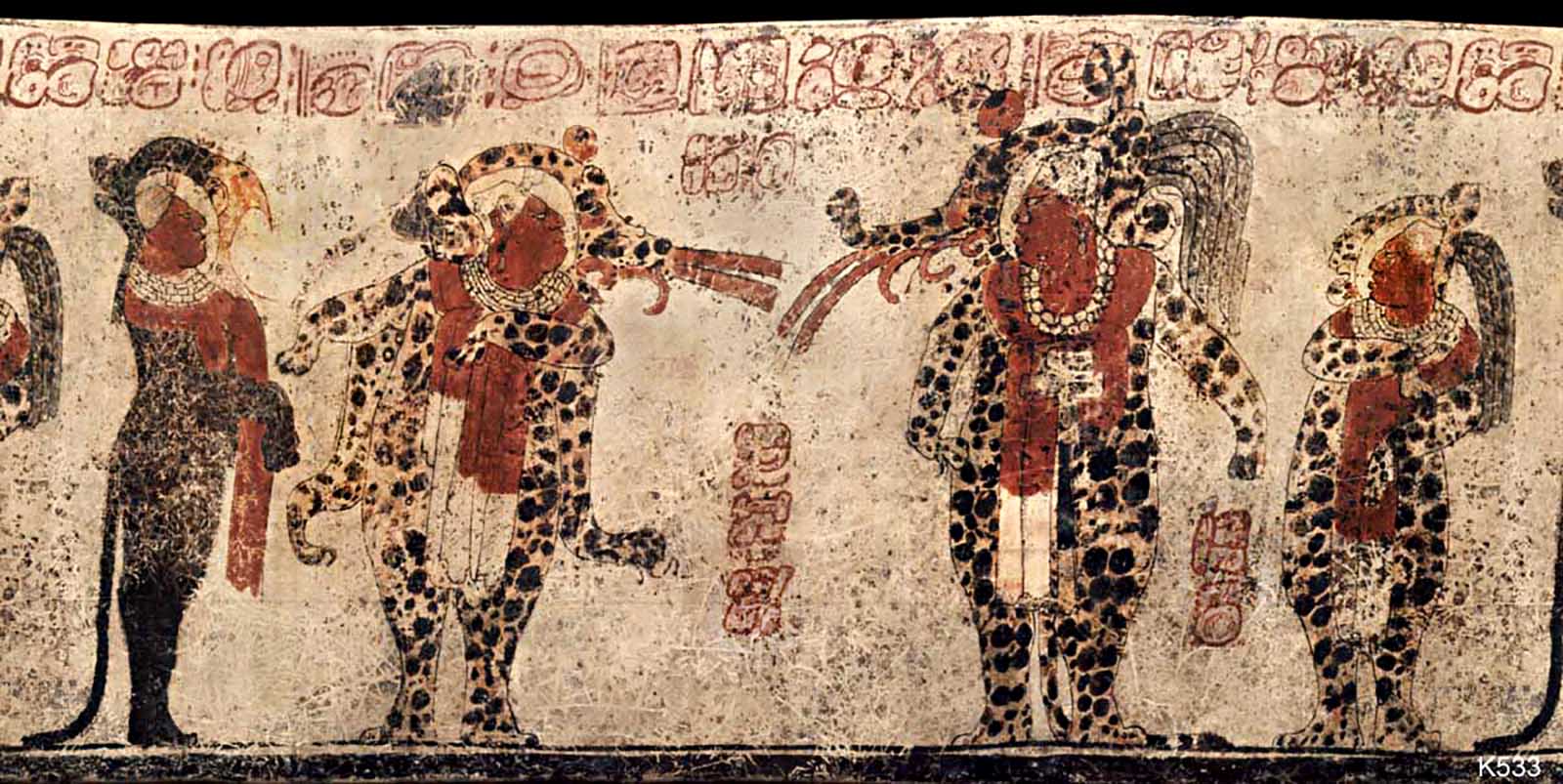
Rollout Vase courtesy of Justin Kerr
Combined with music and the fragrance of burning offerings, dance was often visualized as the direct manifestation of supernatural forces. Matthew Looper, Archaeologist
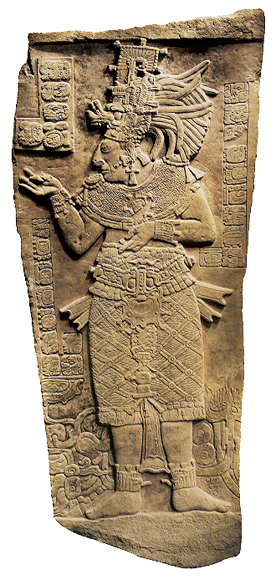
Elite dances depicted in Maya art were part of rituals and celebrations. On sculptured stelae. the kings are shown dancing as a deity. The monuments mostly depict male dancers, but there are some women shown dancing, for instance, Lady Ok Ayiin dancing as the Moon Goddess on the Yomop stela. More often, women are shown as dancers or dancing assistance on painted pottery. Most of the performances on vases show more than one dancer, whereas the stelae only show one or two dancers.
On painted vases dancing is often performed in association with feasting and gift exchanges. On these occasions, a ruler could formalize the political and marriage alliances between his and other elite families. It provided an opportunity to demonstrate his wealth, power and control over the trade in luxury goods. And just as the indigenous leaders of the Pacific Northwest Coast tribes of Canada and the United States gave away their accumulated wealth at lavish potlatch ceremonies, a Maya king could reaffirm polity relationships and his connection with the supernatural world by dancing “in their skins.”
At the level of the court, dance wasn’t just entertainment, it was fundamental to the ruler’s social, religious and political identity, at times demonstrating his continuity with apotheosized ancestors. Through the use of costumes and psychoactive drugs in some instances, dance transported the participants into the supernatural characters they portrayed. It brought them to life.
Occasions
The primary occasions for ritual dancing were accessions to the throne, birth anniversaries, building dedications (Quirigua Altar L), sacrificial bloodletting by a wife (Yaxchilan Lintel 32), celebrations of military victory (Tikal Temple 4 Lintel 3), tribute presentations (El Abra vase) and designations of a royal heir (Bonampak mural),
Components
Resplendent quetzal feathers invested the dancers with the spirit of the bird. The same with jaguar pelts. Seashells connotes the underworld, and Spondylus shells, in particular, were associated with the celestial realm and the rebirth of the Maize God. Mirrors made of pyrite flakes made the dancers sparkle. Bark paper, worn as headdresses and aprons was associated with sacred words (glyphs) and blood sacrifice. Dancing with jadeite conveyed a sense of the breath essence of the soul, the essence of life. White flowers were the visual representation of the soul. The colors and textures of woven fabrics referenced the vegetable world and gardens. And the various colors of body paint and painted cloth referenced an object and its associated myth. For instance wearing yellow, the color of maize, conveyed the notion of abundance and fertility. Red connoted blood; black represented death and blue was the color of “precious.”
Movement
The Spaniards reported that Maya dance was “mannered.” In their art, the upper body doesn’t appear to have played much of a role in dancing. Instead, there’s a slight bending of the knees and a graceful shuffling of the feet. Researchers suggest the movement was at court was either “highly stylized” or “the artists chose a very narrow repertoire of motions and gestures for their canon of acceptable display.”
Dance Of The Colomche
Chroniclers describe a dance with reeds that was much like a game. A large group of dancers formed a circle. Two of them moved to the center to the beat of the music—drums, flutes, wooden trumpets, ocarinas perhaps. One dancer holds a handful of reeds and dances standing up, while the other crouch in a wide circle. The person holding the reeds throws them with all his might to the others and they have to catch them with small sticks.
Dance of the Hero Twins
The dance is based on the Popol Vuh, the ancient mythological text of the K’iché Maya. The performance opens with the appearance of two youths, the twin gods Junahpu and Xbalanque. The Xibalbans, lords of death from the underworld, dance around and try to kill them, but the twins escape their attacks and are unharmed.
Celebrating, the brothers dance in a frenzy and the underworld lords get caught up in it. Hunahpu and Xibalanque flit around with torches, light a fire and wood is thrown into it until the smoke gets dense. Then, facing one another, the twins appear to hurl themselves into the fire. The lords of death follow them. The smoke obscures everything. When it clears, only ashes remain.
Then, on the ground, a compartment opens up, and an emissary in a feathered cape comes out carrying a censer. He points to a chamber off to the side. And with the drums and shell trumpets sounding, the Hero Twins come out covered with beautiful feather capes—their former masks replaced with faces of young lords. They greet the onlookers and proclaim their victory over the fearsome Xibalbans.
Dance of The Warriors
Xq’ul was a war dance. It began with a dancer hunting for an enemy warrior. To the sound of flutes and the beating of ceramic drums covered with leather, enemy warriors come out dressed like beasts—jaguar, cayote, tapir, their identity strengthened with like-in-kind headdresses. The hunters, wearing headdresses of eagles or other birds, dance around them carrying swords, axes and spears. How it ends was not reported.
It’s interesting, the contrast between indigenous dancing where the intent is spiritual and modern dance where, regardless of the style, it’s mostly about personal experience or expression. The former has to do with maintaining and celebrating horizontal (social) and vertical (heavenly) relationships, the latter being individual, even when many people are involved. The one form I can think of that retains storytelling in modern dance is ballet, but even there the stories are about an individual. I’m not saying that our modalities are bad. Considering that our worldview is based more on science than myth, that’s understandable. But in seeing ourselves separate and the world as inanimate, we’ve lost something precious, perhaps essential, in our quest for meaning and more satisfying relationships.
Dancing Brothers: One Lord vs First Jaguar
Excerpt from the novel, Jaguar Rising (p. 166-171)
While the minister and the other dancers got Red Paw into his costume and gave him instructions, two of the drummers heightened our excitement by displaying their speed in twirling and throwing torches back and forth while their brothers pounded the skins of the tall drums.
The dancers came forward escorting Red Paw, now dressed as a messenger with a deerskin apron and a barkcloth overshirt. In place of the owl feather worn by messengers, they’d stuck a broken palm leaf in his headband. His head hung in embarrassment as we laughed and applauded.
The drums stopped abruptly and we became silent. Billowing his cloak again, the minister strode forward with a flourish to begin the story. “There was a messenger of the court—.” As directed, Red Paw ran around the dancers in a circle. Two ceramic drums and now rattles and flutes played by the other dancers quickened his pace. “He ran fast,” the minister said. “Faster! The messenger was true to his master’s words. When he was not running messages, he helped his father in the field.” Red Paw stopped and made the motions of a man casting seeds and tamping them down with a planting stick. Behind him, other dancers comically exaggerated his movements. “He hunted iguana—.” Red Paw turned to the wahy dancer dressed as an iguana and chased him with the stick. “At the men’s house the messenger practiced his warrior skills. He took a wife and he built her a house.” Red Paw pretended to lash poles together. “He was a good husband. He emptied his own chamber-pot!” We laughed as a dancer handed Red Paw a large gourd. He looked into it, sniffed, wrinkled his nose and made the “pot” look heavy, hoisting it to his shoulders. Struggling under its weight, he wobbled over to the initiates and spilled the contents—crumbled dried leaves—onto the heads of the men in the first and second rows.
“Listen now!” The minister shouted over their shrieks and our laughter. “The messenger had a flaw—he was lazy! He only did what he was forced to do.” Red Paw plopped down and lay on the ground with one leg resting on the other knee. “Having found most men to be like the messenger, One Lord and First Jaguar argued among themselves: ‘What is the best way to get the human beings to attend to us, praise our names and feed us their blood and sweat?’” The minister turned to us and opened both arms. “Cerros! This is the question they put to you! The gods tell me they will not release their abundance until it is settled.”
An initiate called from behind saying Red Paw could settle it. When we laughed, my friend raised his hands in confidence and we laughed even louder. The minister stepped back and bowed as One Lord, the dancer wearing a jaguar helmet and wrapped in a cloth with black spots, came bounding down the steps swinging his axe. He stopped here and there thrusting his menacing face close to us. From the stories we’d heard growing up, we knew his pointed tooth was a perforator and that his breath could instantly burn flesh off a bone. Dutifully, we screamed and backed away. When he went to center again, he paced and gestured as the minister spoke on his behalf, directing the words to his brother lord. “First Jaguar! Brother! Maker of men! There is only one way to get the human beings to praise our names and offer us their sweat.” Boom! A drummer pounded. “Watch, we will show you!” Boom! Boom! One Lord pointed and the wahy monkey bounded forward, twirling with a tall wooden box painted with sky signs. Monkey set the “throne” down and One Lord stepped on it. He held his head high, turned to the side to show the mirrors dangling from his belt and he pulled on it to make them clink.
While this was happening, Red Paw received further instructions from the minister. When they finished, my friend went over to the spotted lord, knelt, bowed his head and showed his submission and respect with arms across his chest in the “sky” sign. To the slow agonizing beat of the drums, the other wahyob—Macaw, Jaguar, and Opossum—entered from the side struggling under the weight of a huge boulder. Like their axes it was made of stiff painted cloth, but the way they carried it and set it down in front of Red Paw, made it look heavy.
Again, the minister spoke on behalf of One Lord. “To respect us the human beings need to see that we are powerful.” Behind Red Paw, Iguana got up on Macaw’s shoulders. “We make clouds!” the lord said. Macaw reached into his pouch and rained down ash on Red Paw’s head. Quickly he cowered and brushed it out of his hair. While he was not looking, a drummer approached from behind and pounded his drum hard and fast. Shocked, Red Paw fell against the god-dancer’s feet, nearly knocking him off the little throne. I laughed so hard my cheeks hurt.
The minister spoke for the spotted lord. “We make thunder!” The drummers stood close on both sides of Red Paw and pounded their drums hard in his ears. “We make lightning!” Red Paw crouched as Macaw pummeled his back with palm stems painted yellow. We saw what was coming next. Monkey held an enormous jar over Red Paw’s head. It too was made of stiff cloth but the red rings painted around its neck made it look real. Glancing up Red Paw covered his head. “We make rain!” When, instead of water, more leaves fell, the laughter turned to sounds of disappointment.
As Red Paw shook off the leaves and brushed more of the ash out of his hair, the wahyob set a boulder in front of him. At the same time, One Lord opened his arms to us. “Young men and women of Cerros!” the minister shouted on his behalf, “Did your mothers and fathers teach you properly? Did they teach you to praise our names, keep the count of k’inob and offer us your sweat?” Prompted by our shouts and a dancer standing behind Red Paw, he shook his head emphatically, saying they had. Many of us knew better. “You have seen our power?” Again, Red Paw agreed and the spotted lord turned to him. “We say to you then, praise our names and raise this boulder over your head that we may taste your sweat.”
Red Paw rose to his knees and repeated the words the minister had whispered to him. “With respect, One Lord. Awinaken,” he said. “I praise your name. I will give you my sweat—as one who runs messages. But I do not lift boulders.” The drums pounded fast and stopped abruptly. We were shocked. It was an unthinkable reply. Many of us on the steps, parents especially, made scowling sounds and hurled scolding remarks at Red Paw.
One Lord put his hands to his head as if the reply pained him greatly. The minister spoke his words: “What did you say? It seems we did not hear you correctly.”
Red Paw received instructions again, folded his arms in defiance and looked up at the lord. “With respect lord, I was trained to run messages, not to lift up boulders.” Again the drums. The wahyob dancers had changed their helmets and costumes, coming back as Grasshopper, Snake, Scorpion and Vulture, now rattling threats at the messenger’s head and heels. One Lord danced his anger at Red Paw’s response, twirling around him and the wahyob. In a more demanding tone, the minister, speaking for the spotted lord pointed at the stone and shouted, “Son of Cerros, we order you to lift that boulder!”
“With respect, One Lord. My tribute is to run messages. This is my agreement, my privilege, my obligation to the caah. I—do—not—lift—boulders!” The drummers gave it all they could and the wahyob rattled the lord’s furious dance. When he stopped and pointed to the side, the noise stopped. A dancer dressed as a warlord pulled a captive woman onto the plaza by a cord around her neck. Her head was down and her hair covered her face. We’d not seen her before. All the dancers were men.
The warrior pushed the woman to the ground beside Red Paw and pulled the cord tight so she would rise to her knees and look up at One Lord. Higher up, someone in back of me whispered that it was Lady Sandpiper, second daughter of Laughing Falcon. Others agreed and word spread. To see a hot- blooded Cloud kneeling next to Red Paw was amazing. To see her wearing a barkcloth sarong with her hair hanging down and strips of cloth pulled through her ears was unbelievable. The dance was her father’s surprise. Seeing his daughter bound and treated like a captive was an even greater surprise.
When the murmuring among us stopped, Lady Sandpiper—the captive—bowed to One Lord. Scorpion handed the god his bloody axe and he held it over her head. The command came again—“Son of Cerros! Raise that boulder! If you do not, we will harvest the head of your wife!” His wife? That was funny. But when Red Paw turned and smiled at us with a stupid grin on his face, my friends and I almost fell off the steps laughing. After the minister whispered something to Red Paw, my friend bowed to One Lord, loudly praised his name and took hold of the boulder. Slowly, laboring under the weight, he lifted it over his head with wobbling legs. One Lord turned to First Jaguar with crossed arms and a satisfied posture. “You see my brother,” the minister said. “This is how we get the human beings to praise our names and offer us their sweat!” We applauded, stomped our feet and shouted. The wahy dancers stepped back to change their helmets, and the god dancer stepped down from the throne.
While both gods wore jaguar helmets, we recognized One Lord by his black spots and First Jaguar by orange-and-black tufts pasted onto his skin. Also, he wore rounded jaguar ears and paw mittens.
First Jaguar crouched and pawed at the women, then the men. Finally, he stood on the skybox throne. As before, the minister spoke for him, exalting him as one of the lords of the night. Instead of threatening Red Paw, First Jaguar presented him with gifts—a brown cloak, a planting stick and a spear for hunting. Following instructions again, Red Paw danced a hunt by chasing the wahyob demons who now wore tapir, fox, deer and peccary headdresses. After applauding the capture of his prey, First Jaguar gestured and Red Paw assumed a kneeling position. Lady Sandpiper came forward, now wearing a shell necklace over a plain white sarong with her hair wound high into a braid with spiraling red ribbons. “You have shown us your goodness and loyalty,” the lord said to Red Paw. It would please us if you would accept this beautiful woman as your wife.” Lady Sandpiper held out her hand toward Red Paw and he bowed.
Hoots and whistles turned to laughter and cheers as Red Paw danced around the lady to the sweet sounds of a bamboo flute. When First Jaguar gestured to the ground in front of him, Red Paw went before him and knelt. “You are a good and loyal messenger,” the lord said. “Speaking words properly and repeating them with care is a sign that human beings are well made. Also, it shows you respect your masters and their words. Now, from the River Of Abundance, it is our pleasure to give you everything you need and want.”
After some prompting Red Paw replied, “With respect, First Jaguar, Lord of the Night. Awinaken. I am grateful for all that you have given. What can I offer you in exchange?”
The First Jaguar dancer looked our way, tilted his head and raised his hands as if to say the argument was settled. During the applause Tapir, Fox and Peccary got the boulder and set it in front of Red Paw. “Faithful messenger,” First Jaguar said. “It would honor us greatly if you would praise our name and raise this boulder over your head.” Without hesitation, and to our foot stomping and shouting, Red Paw loudly praised his name, lifted the boulder over his head and paraded it around the dancers. First Jaguar folded his arms and turned to One Lord. “Brother,” he said. “Do you see? This is the better way to get the human beings to praise our names and offer us their sweat.”
Our applause continued as the minister, Red Paw and the gods came forward. “Son of Cerros,” the minister said. “You have witnessed the arguments of the god twins. Now, the burden is yours. Tell us, which of them carries the greater argument?”
____________________________________________________________________________
For a brief description of The Path Of The Jaguar series go to the Home Page—Novels
Links To Amazon.com for paperback books and Kindle Editions—
Jaguar Rising: A novel of the Preclassic Maya
Ancient Maya Social Evolution (Part III)
Part III of III: From chiefs to divine kings

Rollout vase photograph courtesy of Justin Kerr
The previous two posts dealing with this topic imagined how the ancients developed and sustained a political structure and ideology over an enormous territory for a millennia but never developed states or empires. Now, I imagine how the office of village chief evolved to become, in their language, k’uhul ajaw “holy lord.”
In *Ancient Maya Politics: A political anthropology of the Classic Period 150-900 CE anthropologist Simon Martin suggests that “Ideological mechanisms instilled a ‘dynamic equilibrium’ within the social body that prevented the Maya from developing states or empires.” Here, I attempt to imagine a plausible line of development that specifies that dynamic equilibrium.
Maya Civilization Time Periods
- Middle Preclassic 900-300 BCE
- Late Preclassic 300 BCE-250 CE
- Early Classic 250-600 CE
- Late Classic 600-900 CE
In Part II of this series, I listed some of foundational beliefs of the Early and Preclassic Period Maya. Beliefs give rise to behaviors. So, what methods did the rulers use to sanction and spearhead their rise to “divine” kingship? It became the ultimate validation they needed to justify their right to rule.
Language
Well established by the Late Preclassic Period, the Maya had terms relating to spirit, but they were not yet used to characterize rulers. These included:
K’uh “God” / “Divine” K’uhul “Holy” / “Sacred” Ajaw “Lord”
K’uuh “Sun” / “Radiance” Ch’ulel “Soul” / “Spirit”
The earliest evidence of an individual being designated ajaw “lord,” occurs in an elaborate tomb at Holmul, Guatemala dated to 350-300 BCE. Whenever or wherever it happened, it lit a socio-political spark that elevated the head man, likely a shaman, from the role of healer to that of ajaw. Not only could he heal the sick, he could also speak to the gods.
Beliefs are creative. Across cultures, when it’s believed that an individual with some power has great power, especially spiritual power, he is encouraged to lead his people. By ritually acknowledging that person as a leader set above everyone else, “hierarchy” is born. For the Maya, over time, the leadership of lords turned to domination, in part by making rules among their people and appointing others to implement them. These “rulers” laid the social groundwork for “civilization.”
Sometime before 250 CE rulers began to claim that they were the descendants of the founders of their lineage and polity. Through grand ritual performances, they demonstrated that they could communicate with their deceased ancestors—the founders—as well as the gods. The move affected a shift in their identity from mediator between this world and the next, to being considered god-like lord in their own right.
Emblem Glyphs
One way to do affect this shift was to claim the title, K’uhul Ajaw “Holy Lord,” and broadcast it. A prominent step forward was to commission the carving of “emblem glyphs” on stelae. In this way the kings associated themselves with divinity. An example reads: “Yax Nuun Ahiin I, Divine Lord of Tikal.” Whoever started it, by the Late Classic Period, emblem glyphs were being used widely by major polities throughout the Maya area.
Conjuring
Kings demonstrated their access to the gods directly through conjuring rituals, often involving bloodletting sacrifices. From movies comes the image of a shaman or witch doctor under the influence of a hallucinogen, dancing wildly to loud drumming around a roaring fire with a circle of frenzied onlookers.
The stereotype probable isn’t far off. There is good evidence that the Maya used psychoactive substances that were obtained from plants, particularly Morning Glory roots and the back of Bufo toads. There are also depictions on vases that show kings dancing with gods, other supernatural beings and Underworld demons.
The purpose of conjuring is to bring a god or spirit into being, inviting them to be present for a variety of reasons. Because the conjuror actually produces evidence of their presence—through magic, spells or ecstatic communication—we can imagine that these performances had a profound effect on those who witnessed them. Importantly, it solidified belief in the spiritual power of the king.
One of the earliest deities conjured was K’awiil, a lightning lord. He was so important in the Maya firmament, kings in the Classic Period took his name to show they embodied his power.
Intimate, transactional relations with deities were required to sustain the whole community.
Simon Martin, Anthropologist
Stelae
Kings commissioned the carving and erection of stelae that showed the lineage founders overlooking them. Tikal Stela 29, the earliest at the site, shows Sak Hix Muut, whom researchers consider a deity-ancestor. He hovers above the king, looking down on him as if from the sky. The image sanctioned the king’s right to rule and made it clear that he was in communication with the spirit world.
The Calendar
Scholars refer to the sacred calendar of the Maya as the tzolk’in, a word in Yukatek that means the “division of days.” The 260-day calendar combines a cycle of twenty named days (designating auguries for each) with a cycle of thirteen numbers. It’s origin actually predates the first appearance of Maya inscriptions.
Ajaw, the rank of “lord,” was accorded the name of the last day of the calendar. With a king’s face carved within the glyph’s cartouche on a stela or altar, he became intimately associated with time, which was perceived as gods of time carrying burdens on their backs through the seasons. The day ajaw was particularly significance in that all Period Ending celebrations fell on that day. Throughout Maya history, Period Ending rites were major events, a regular feature in the inscriptions. In large part, it was the P.E. dates that jump-started progress in deciphering the script.
Ritual Dancing
Dances are frequently depicted in Maya art. Most obvious in associating the king with a god were polychrome vases often gifted from one ruler to another. The subtextual message was simply “See, I conjured a god and let him dance in my body.” It was one of the ways a ruler could demonstrate to another ruler, that he had divine powers. One of the more prominent examples in Maya art are vases that show a king dancing as Juun Ixim, the Maize God.
In the dance, the king assumes the appearance and gestures of the Maize God. (His head was already shaped like a corn cob at birth). His flowing hair resembles the silk and he carries a jaguar god within his backrack (the cosmos). Every element of his costume symbolizes his connection to the godly realm and divinity.
As described in my novel, Jaguar Sun (p. 284), the dance begins with the Paddler Gods escorting Juun Ixim into the Underworld in a canoe. Their descent is through a cave, a portal located beneath a sacred mountain. There, the Maize God’s soul is separated from his body by decapitation (like a cob of maize chopped from the stalk). After encounters with beings in the Underworld, he is reborn and rises into the light (as does a new plant) through a slit in Great Turtle’s carapace (the surface of the earth), which was cut open with a great axe wielded by Chaak, god of rain, lightning and thunder.
Researchers generally agree that the dancing kings were not imitating the gods, but actually dancing as them, re-enacting their deeds in the present.
Patron Gods
In Patron Gods and Patron Lords: The Semiotics of Classic Maya Community Cults, anthropologist Joanne Baron writes that “rituals and discourses related to patron deities ultimately formulated Maya rulership as a locally oriented institution, which limited the ability of powerful kingdoms to create wider religious communities.” Her analysis directly addresses the reason why the ancient Maya never evolved into states or empires. The kings were locked into their local territory because they’d traced their ancestry and power to the lineage founder, and they’d established a spirit protector for the polity. It was inconceivable to let go of their divine-line inheritance and their spirit protector—the patron god— not after they and their ancestors went to so much effort over many generations to establish them. It would mean giving up their power.
Patron gods were neither the spirits of natural forces nor the deceased ancestors of rulers, but they could be versions of them. As protectors and providers of the polity, each king “owned” one. They were cited in the inscriptions to demonstrate a king’s connection to these protectors and providers from the other world.
Details of their lives were carved on monuments. For instance, the patron of Palenque was “Muwaan Mat,” a mythical deity-ancestor born in 3121 BCE. He/she appears there in 2324 BCE and was 797 years old when the inscription was carved. In the Late Classic period, Palenque honored three such patrons, building separate temples or “sleeping places” for them.
An inscription at Naranjo speaks of “Square-nosed Serpent,” a patron who performs a ritual act 22,000 years ago. On Stela 45, he’s shown floating above the king.
At Tikal, the patron god Sak Hix Muut “White Jaguar Bird” appears on Stela 29 in 292 CE. On Temple VI he’s said to preside over the completion of a calendar cycle in 1143 BCE. Tikal didn’t even exist then.
In the Late Classic period, small patron god bundles, and large full-figure effigies were traded, gifted and won in battles. Carved wooden lintels at Tikal show enormous patrons towering over enthroned kings being carried in procession on huge palanquins. The patron deity depicted on Tikal’s Temple 1 Lintel 3 (scroll down 11 drawings to Caption JM00725) takes the form of a giant jaguar beastie with and extended paw and claws. Spectacles such as these solidified the identity of the ruler as a “divine” lord.
Temples to House Patron Gods
When not being paraded in the form of giant effigies, the patron gods “lived” in temples specially built and dedicated to them. By making these structures massive and tall, kings signaled the importance of these deities in the life of the polity. And they were ever-present. As shrines, we can imaging the plazas in front of them were places where people came to offer gifts and pay homage while holy men burnt offerings on the ground and in censers.
The hieroglyphs on the back of Tikal Temple VI tell the story of co-rulers, one of whom was a woman. They also identify it as an ancestor shrine, the wayab “sleeping place” of Sak Hix Muut (noted above as a founding ancestor). The temple was dedicated in 766 CE.
These are just some of the more prominent ways that, over time, Maya kings validated their claim to be “divine,” god-like lords. The ability to commune with both gods and deceased ancestors on behalf of their polity also legitimized their right to rule. At the same time, it’s important to include in this calculus that rulers, close-by and distant, were in touch with one another, sharing information and modeling each other’s behavior. “If he can do it, so can I.”
People who are fearful in their environment, rightly so the jungle, needed to feel secure. Naturally, they turned to their leaders. They needed to believe they could have at least some influence over the gods—the forces of nature. Doing the bidding of the rulers, building their temples and palaces in addition to devoting every other hour to subsistence and raising a family was readily traded for security and the hope for prosperity. The hierarchical structure worked for them, at least for hundreds of years.
* This book is an excellent text for those well read in the study of ancient Maya culture. It assumes a familiarity with Maya sites, hieroglyphic writing and social structure.
Excerpt from
Jaguar Sun: The journeys of an Ancient Maya Storyteller
A patron god towers over the Lord of Tikal on a palanquin (p. 190-193)
Following the singers were daughters of the caah, little flowers carrying baskets of petals, casting them at the feet of the bearers who carried the palanquins of visiting lords. Behind them were their robed dignitaries, including members of the K’uhuuntak Brotherhood wearing their usual white robes and tall paper headdresses. The sight of so many people in one place reminded me of when Eyes used his blade to slice through and reveal the inner workings of an ant hill. I wondered, How big is this world that there can be so many people? And this just one among countless cities. With the last of the visiting lords installed on thrones atop a specially erected platform on the palace steps, the drums and the plaza quieted. After a row of holy men and their assistants sufficiently censed the entryway, a lone conch sounded a sustained tone, calling for us to stand.
THROUGH THE SMOKE OF NUMEROUS CENSORS, JAGUAR heads appeared on the front corners of the swaying, highly polished mahogany palanquin. Behind them, two red-painted dwarfs stood with their backs to us. Embroidered on their white capes was the face of Tlaloc, the storm god of Tollan, reminding us that this day was a commemoration as well as a victory celebration. The white skulls hanging from the dwarf’s belts sent a chill through me. In front of them there were two more little men, similarly attired, swinging censers. Beneath the long platform, slaves, too numerous to count and wearing only white loincloths, bore the weight on their shoulders.
The Lord of Tikal sat on a jaguar pelt holding a K’awiil scepter in his right hand. The little god’s serpent foot rested on his thigh. The other hand grasped a long, red-painted fabric bundle which, because of the stone face sewed onto the side, I took to be either his or a captured god-bundle. Rising well above the ruler’s headdress and a fan of quetzal feathers, the patron god of Calakmul, Five Bloodletter, looked even more menacing than Underworld Jaguar. Like him, his orange and black arms were extended. As a sign of sacred power, the Jaguar’s great paw grasped a tall black staff tied with white knots.
From such a distance, I couldn’t see the ruler’s eyes. Moments passed. Then suddenly, I needed to see them. Seeing where the palanquin would stop, I saw a possible opportunity to get closer.
I went down the back steps, ran around the backs of the shrines and the ball court. I’d seen a stack of torches, hundreds of them, and guessed that they were for the warriors. The walkway that led out to them was unguarded. I didn’t know what I was going to do with them, but I grabbed an armload and took them behind a wall where I wouldn’t be seen. Moments later, someone barked an order and I peeked out to see warriors streaming by to get a torch, hold it to the flames in a brazier alongside the stack and move on. I couldn’t pretend to be one of them, so I waited and tried to think how I could get closer. Fortunately, the warriors were coming so fast the men distributing the torches were having trouble keeping up. That was when I took a chance and approached, carrying so many they could barely see my face. “Where do you want these?” I asked.
A warrior busy handing out torches glanced back. “Who are you?” he asked. “Never mind.” He pointed. “Go over there and hand them out—fast as you can!”
After the warriors had all received their torches and were in position—the plaza looked like it was on fire—I was able to stand with a torch of my own and watch the ruler’s palanquin come toward me.
LORD SKY RAIN WAS YOUNGER THAN I EXPECTED, not much older than me. Sitting erect and gazing forward with a solemn expression on his face, he seemed to say he deserved to be treated like a god.
The bearers stopped and set the platform down gently, being careful to keep it level. The dwarfs—revered beings sent by the sky gods to honor and assist rulers—approached their master. One of them held out a long red pillow to receive the scepter. Another took his embroidered, pearl-studded tobacco bag, and the other two held their censers to the side, careful to keep sparks away from the quetzal spray that, when the ruler stood, framed his body and towered nearly the height of a man over his head.
As bearers on the palace steps positioned six planks to create a bridge from the palanquin to the stairway, twelve lords approached, six to a side wearing quetzal sprays with necklaces of Spondylus shells over their cloaks. A moment before two holy men crossed over the little bridge to offer their arm to the divine lord and block my view, I tried to see the man behind the jewels and feathers, the one who ordered the killing of my father, brothers and so many others. Instead, I saw a young man barely able to stand, weighted down by a headdress of stacked sun god masks with heavy ear ornaments, jade assemblages in his own ears, a large jade pectoral that rested on a cape of shell plates, carved jade heads larger than a fist hanging from a wickerwork belt, two jade faces, likely ancestors, strapped to his legs and high-backed feathered sandals.
Seeing all that finery and regalia and knowing what most of it meant, I almost felt sorry for him. He was an animal in a cage without bars, born to a life of fulfilling family and ritual obligations including the expectations of his council, court and ancestors. He had to consult and adhere to the guidance of his patron gods, however many there were. And he had to defend the city against his inherited enemy who, for years, had been recruiting allies to surround his city.
As he was escorted across the bridge, he kept looking down. He looked at me. It was only a glance, but in his eyes, I saw worry rather than triumph like he was afraid he would lose his balance or the planks would break.
AT THE TOP OF THE PALACE STEPS, STANDING BETWEEN eight torch bearers and his dwarfs, Divine Lord Sky Rain K’awiil, blessed the crowd of bowed heads. He was about fifteen steps above me, but because he spoke softly and I held a torch, I couldn’t hear what he said. Turning, he and his frame of feathers disappeared behind the platform.
___________________________
Available on Amazon.com and Kindle Editions—
Jaguar Rising: A novel of the Preclassic Maya
Ancient Maya Social Evolution (Part II)
Part II of III: Ideological foundation

The question I posed last week was how the ancients developed and sustained a common political structure and unified ideology that covered an enormous territory (Guatemala, Belize and southeastern Mexico) for over a millennia. I imagined how their political structure might have gotten started and described how it might have grown from small villages with a “chief” to cities with divine kings, monumental architecture, hieroglyphic writing and a unique art style.
Again, my catalyst for imagining these developments is *Ancient Maya Politics: A political anthropology of the Classic Period 150-900 CE by anthropologist Simon Martin. He suggests that “Ideological mechanisms instilled a ‘dynamic equilibrium’ within the social body that prevented the Maya from developing states or empires.” Stitching together his comprehensive analysis with items from my databases, this is my attempt to plausibly imagine how that could have happened.
The earliest Maya settlements date to around 1800 BCE, but because new finds keep moving that date back, I’m going to imagine that around 2000 BCE groups of farmers living along the Gulf coast of southern Mexico began to explore the jungle territories south and east. The date is also reasonable to assume because the Olmec of Veracruz and Tabasco were creating stone monuments by 1600 BCE. Whatever motivated these farmers and families, it had to be serious because cutting a path through dense jungle and swamps to find a place to settle was difficult and dangerous.
An ideology is a system of beliefs that attempt to explain the world, our place in it and how best to adapt or change it. Because a seemingly unique ideology always emerges from the way people before them lived and organized themselves, the Maya story had its roots in the values, ideas, rules, perceptions and lifestyles of those early maize farmers.
As to the uniqueness of ancient Maya ideology, I imagine it developed rather quickly in response to the need to subsist and survive in the jungle. While they had inherited certain beliefs about the sun, moon, maize and rain deities and how their leaders negotiated with them, the environmental pressures imposed a more urgent and dramatic response, a radical change in worldview and lifestyle.
Suddenly, these farmers had to adapt to seasons that alternated between extremes of relentless downpours with body-wrenching thunder and lightning strikes and droughts without surface water. The Peten jungle had no rivers, streams or lakes. Roofs had to be built, landscapes altered, cisterns and reservoirs dug to collect and hold enough rainwater to last through the dry season. With only stone tools and no wheels, planting required an immense effort of clearing tall trees with supporting buttresses, chopping and burning the dried wood, planting seeds with a stick and keeping watch over the plot to ward off animals.
Certain trees and thorns were poisonous if touched, and many fruits and berries were toxic. Without knowledge of parasites and viruses, people were getting sick and dying for no apparent reason. They regularly dealt with insect bites and deadly snake bites. And jaguars and crocodiles would attack small children. We can imagine that life expectancy around that time hovered between the late forties and early fifties.
Over the space of a few generations, the descendants of these early immigrants developed a great deal of knowledge about life in the jungle. From observation alone, they became acutely aware of and predicted the movements of the sun and moon. And because the night’s sky was lit brightly with billions of stars and the Milky Way, they kept track of them by name, gave them personalities and correlated them with patterns in everyday life.
Survival in a hostile environment requires paying attention to everything that could possibly be harmful. Everything in the natural world, animate or not, was possessed of a spirit, so these had to be respected and offered gifts. Likewise, the forces of nature (rain, lightning, thunder, wind, hurricanes), which were considered to be supernatural beings. And significantly, interpersonal relationships, trading, warfare and everyday life had to be structured in accord with the perceived order demonstrated by the sky gods. Thus, the phrase “As above, so below.” Besides the responsibility to heal sickness and treat injuries, the shaman conjured ancestral spirits and negotiated with supernatural beings.
While the outer trappings of their activity was ritual communing and communicating with the gods and deceased ancestors involving psychogenic drugs, trance dancing, bloodletting and outrageous behaviors, it was the subtext of these performances and their repetition that ramped up and over time cemented the Maya’s ideological beliefs. Because he was possessed of heightened powers, it was natural for the shaman to eventually assume the role of “Chief” in the Early Preclassic Period, “Lord” in the Late Preclassic and “Holy Lord” (Divine King) in the Classic Period.
Some of the formative, subtextual beliefs included:
- Everything in the natural world is either a god or inhabited by spirit.
- The world was created by cooperating deities.
- Gods are like men. They have personalities, likes and dislikes. They fight among themselves and need to be fed. They are brought into being and made present through conjuring.
- Having created the world, the gods can end it on a whim. Take nothing for granted.
- Juun Ixim, the Maize God, established and maintains the cycle of life—birth to death.
- Blood is the source of life; ch’ulel, the “soul” or “spirit” lives within it.
- K’inich Ajaw, the Sun God, needs sacrificial blood to survive.
- Time is cyclical; what happened before will come around again.
- Supernatural beings and deceased ancestors are not elsewhere. For good or evil, they are here, active in everyday affairs.
- Holy men effectively negotiate with the gods by giving them what they want.
- The gods want respect, praise, sweat from labor and blood offerings. It sustains them.
- When the gods are pleased the polity thrives.
- Caves are sacred portals to the Underworld, the domain of demons that must be fed.
- Life descends from deities in the sky.
Ideological beliefs (“memes” in scientific terms) survive through repetition. In time, they become common knowledge—when they’re repeated by diverse sources, illustrated in stone, codified by being written and referenced in myth, song and storytelling. Sustained through generations, everyday people accept a belief as true. They will say “Everybody knows…” “It’s obvious…” Acting in concert with beliefs becomes second nature. Until they’re proven wrong. For instance, we now know that Christopher Columbus did not discover America. And Native American culture is not inferior to European culture. It’s just different.
* The book is an excellent text for those well read in the study of ancient Maya culture. It assumes a familiarity with Maya sites, hieroglyphic writing, monuments and social structure.
TO BE CONTINUED
Next week Part III: Given the beliefs that set the stage for Classic period ideological expression, how did the office of village chief evolved to become a k’uh ajaw “divine lord.” And what kept the Maya from developing states or empires?
Excerpt from:
Jaguar Rising: A novel of the Preclassic Maya
(A band of traders paddle their way through a snake-infested, flooded forest. p. 249-251)
Aside from the dripping sounds, the quiet lasted about ten heartbeats. Thunder Flute stepped up on the bow beam. “Coxswains! Form a line! Tie the bows to sterns. Use two cords and tie the knots tight. Whatever happens, we must not get separated. When the trees get closer, keep your hands off the gunwales. Watch for snakes—in the trees and in the water. They are hungry and vicious. Yellow jaws and moccasins can climb into the canoes. When you use your paddles to fend off trees, watch and turn them over. If you hear little coughing sounds the yellow jaws are already too close. Keep your blades at hand.”
PADDLING TROUGH DARK AND FLOODED FOREST WAS SLOW and frightening, filled with annoyances—the drone of howler monkeys, spider webs the size of a man and damp clothing that pressed cold against the skin. Worst of all were the mosquitoes and biting flies. Without mud or smoke, we just had to endure them. It felt like the Chaakob were tormenting us, pouring dove rain, then otter, then turtle and otter again. They never let up. Pech, whose muscles and skin seemed to defy all torments, welcomed the rain saying we needed the water to rise. We didn’t say anything about the frequent scraping sounds and jolts that came from under the boats, but I wasn’t alone in wondering whether we were passing over the underbrush or if an underworld demon was complaining about our being there.
The trading assistant was right to worry about the tangle. The forest became so dense in places Thunder Flute led us around rather than between trees and brush. As warned, we saw plenty snakes—long black one, speckled racers and blunt-heads. Most common, were the green tree-snakes and water moccasins. In one place, Thunder Flute’s coxswain smacked the water with his paddle to deter one that was coming fast. I thought I saw a yellow-jaw hanging from a branch, but Thunder Flute picked it off and held it up to show us the bulging eyes and thin snout of a non-venomous cat-eye. On another tree, he showed us a moth bigger than his hand. Had he not coaxed it to move I wouldn’t have even seen it.
With purple sky still showing above the canopy, the lead canoe came alongside some leg-thick vines that stuck out of the water looking like the backs of serpents with their heads and tails in the underworld. Thunder Flute called for all stop. “We sleep here tonight! The vines point east and west. That way is west,” he said, pointing. “Tie the boats together and lash each one to a separate tree— not the vines. Because of the snakes, use only one cord on the tree—and keep an eye on it.”
“All night?” someone asked.
“All night!” Pech emphasized. We broke out some food and listened as he assigned the watch. “When it gets dark,” he said, “the eyes you will see are either crocodiles, owls or eagles.” You will hear noises. Mostly frogs, insects and howlers. Keep a weapon close at hand, even as you sleep…”
Thunder Flute knew I was good at drilling fire, so he volunteered me to come under his canopy and light the one torch he allowed. The tuft was damp but I finally got it going and set the torch in the holder on the bow. I returned to my position in the other canoe, huddled under a blanket, swatted mosquitoes and listened to the drip, drip, drip…
I was nearly asleep, when someone shook my shoulder. “I think you want to see this,” Pech called out. I sat up to a sight so amazing I rubbed my eyes to see if it was real. The flooded forest was ablaze with twinkling yellow lights, thousands of them, all around, high and low. Fireflies were common at Cerros, but these were as big as eyeballs. And so bright their twinkling was enough to reveal the trees and the other boats, even our faces. Wondrously, their reflections on the black water made it seem like they were in all three worlds at once. Pech caught one in his hands. “Pass this to Fire Eyes,” he said. “Our gift to him,” he said louder. “On this k’in, fifteen tunob past, he touched the Earth.”
He remembered! Or Thunder Flute could have told him.
As the others applauded, the wonder of the blinking light that filled my cupped hands with yellow light reminded me of my journey into the sky.
THE SOUND OF BRANCHES SCRAPPING HARD AGAINST THE bottom of the boat startled me awake. The crew was pushing off the trees with paddles, moving slowly through a fog that obscured the canopy. I couldn’t even see the last boat. We kept getting into thickets where we had to turn around and go another way, always watching the vines to keep us going west. Each time it happened it wasn’t just disappointing, it raised doubts that Thunder Flute and Pech could get us out of there. They told us to keep looking for broken pods, maize stalks, clothing, thatching or cording, anything that might indicate habitation, but there was nothing like it.
The second night on the water was much like the first—dripping from the canopy, an occasional snake, the persistent and maddening sound of frogs, fireflies and crocodile eyes.
The fog wasn’t as thick as the previous morning, but we still had to turn around three times. There’d been only two notable events that day. Within moments of Pech pointing to a bird calling waak-ko, waak-ko, a laughing falcon grabbed a snake off a branch. The other was when one of the bearers dropped his paddle in the water and it floated off. Thunder Flute had us all stop and wait while they tied a cord around the paddler’s waist so he could jump in and retrieve it. By nightfall, he complained of weakness, a sore throat and a dripping nose, irritations that would plague the rest of us for the next eight-to-ten days.
_______________________________
Available on Amazon.com and Kindle Editions—
Jaguar Rising: A novel of the Preclassic Maya
Ancient Maya Social Evolution
Part I of III: From farmers to divine kings and villages to cities
One of the great wonders of Classic Maya civilization is how they developed and sustained a unified political structure and ideology that covered an enormous territory (Guatemala, Belize and Southeastern Mexico) for nearly a millennia.

In *Ancient Maya Politics: A political anthropology of the Classic Period 150-900 CE, anthropologist Simon Martin suggests that ideological mechanisms instilled a “dynamic equilibrium” within the social body that prevented the Maya from developing states or empires. Stitching together his comprehensive analysis with items from my various databases, this is my attempt to imagine and generalize their evolutionary process.

Architecture 18 ft. across at Cuello in Belize dates from 2600 BCE. This means the site was occupied much earlier. Let’s say you were born and raised there. Your family is one of several that had cleared an area of the jungle that stayed dry through the rainy seasons. Most of your time was spent on subsistence—hunting with spears, blowguns and traps, gathering fruit and nuts and farming maize, beans and squash.
It was well known that your grandfather was a warrior, a protector. In his youth he fought bravely when the settlement was attacked. Years later, revered as a shaman who could communicate with the gods, he became the head man. Because of your grandfather’s demonstrated success in negotiating with the gods, everyone understood that his blood was special, derived from the sun god. When he died from a snakebite your father inherited his powers.
Emboldened by this recognition, in solemn ceremony your father received his father’s paper headband, gourd-rattle and baton—a stick with the menacing face of the lightning god carved into it. Raising it to the sky, he proclaimed himself “Chief of the Headband People,” a group that numbered close to a hundred. By that time, all the settlements within a day’s walk had an identifying name and were ruled by men who claimed blood inheritance from the sun god. As anointed ones, they all wore paper headbands and carried carved batons.
As the settlements grew to become villages with far-reaching trading partners, the quantity and variety of goods increased. Offered to chiefs as tribute to win respect and favors, were the most prized items, among them resplendent quetzal feathers, spondylus shells, jade, jaguar pelts, cotton textiles, cacao beans and stingray spines.
Significantly, these transactions included conversations about the gods and perceptions surrounding the legitimacy and power of other chiefs. Enjoying their prosperity and elevated status, some of them consolidated power to become rulers, officially having themselves raised in grand ceremonies to the status of ajaw, “lord.”
 Accordingly, their costumes became more elaborate incorporating symbols that supported their legitimacy to rule on every item. Private indoor rituals expanded to become grand and dramatic outdoor performances that marked calendar stations, honored patron gods, made preparations for war and witnessed status changes within the royal family. Increasingly, they received emissaries and dignitaries from distant regions, trading even scribes and craft persons—all the while growing a family, initiating and overseeing building projects.
To manage all this, it became necessary for the lords to establish a hierarchy of authority. Members of the royal family, friends and trusted others were elevated to responsible positions, all of which came with a title.
In the beginning of the early Preclassic (700-300 BCE), villages grew quickly. Although Tikal was just getting settled, by the end of this period, nearby Nakbe already had well-defined administrative systems in place, and one building there exceeded 65 ft. in height. As a result of agricultural successes, the lowland jungle blossomed with hundreds of villages. A monument dating to 400 BCE at El Porton in southern Guatemala, was among the first to erect a paired stela and altar showing hieroglyphs and numerals.
In the jungle lowlands, 250 to 100 BCE, Tikal began serious urban development. El Mirador was well underway toward becoming an immense city, raising towering temples (El Tigre was over 250 ft. tall) with huge colored god-masks plastered on their flanks. Hieroglyphic writing was well underway, and lords were establishing themselves as kings with a direct line to the founder and from him to K’inich Ajaw—symbolized by being wrapped in the sak huunal, the “holy headband.” Around 100 BCE, painted murals at San Bartolo depicted the maize god and the crowning of a king with the sacred headband—to showing that the divine right to rule came from the gods. At the same time, Kaminaljuyu, a sprawling city in the southern highlands and the dominant trading power in all directions, was erecting stelae depicting gods (not yet rulers).
Approaching the new millennium, Nakbe was abandoned. Kaminaljuyu followed soon after, then El Mirador around 200 CE. Like dominos falling and for reasons not yet known, most major centers, including Tikal and Cerros, a once vibrant trading center in Belize, were abandoned.
A few centuries later, lowland culture returned with kings and “Long Count” calendar dates appearing on stelae in full fluorescence.
Emerging from the social and demographic collapse that brought an end to the Late Preclassic Period (400 BCE—150 CE), this new tradition developed its distinctive character during the transitional Protoclassic Period (150-300 CE), before spreading outward from the central southern lowlands.
Simon Martin, Anthropologist
Needing to legitimize their authority to rule over expanding territory and larger populations, the lords began to assume the title k’uhul ajaw, “holy lord.” Where the dynastic founders had carved the visages of gods on the sides of their temples and stone monuments, by 250 CE the holy lords were having images of themselves carved in stone with the founders hovering over them. By signaling their continuing access to the founders, the kings shifted their identity from mediator between worlds to god-like lords in their own right.
To secure and broadcast their sacred status far and wide, the kings adopted what scholars refer to as “emblem glyphs” that have three elements that are read phonetically: k’uhul “divine,” signified by drops of blood, ajaw, “lord,” and a variable main sign, the name of a district or polity. For instance, the emblem glyph at Tikal citing the founder of the dynasty reads: Yax Moch Xoc Mutul k’uhul ajaw, “Yax Moch Xoc, Holy Lord of Mutul. (Yax Moch Xoc (219-239 CE) founded the dynasty, and Mutul is the ancient name of Tikal. In this case, the sign for Mutul is the knot of a headband viewed from behind. The pattern and translation of emblem glyphs led anthropologist Peter Mathews to conclude that they were mostly assertions of political autonomy. Today, wherever these glyphs are found, researchers are learning the ancient names of kings and dynasties.
Returning to our question: How did the ancients develop a culture that maintained strictly hegemonic polities and a unified religion that covered an enormous territory for nearly a millennia—without developing states or empires? Considering the foregoing, one of the contributing factors was the widespread and commonly held belief that blood—being red and the substance of life derived from the sun god—was operative from beginning to end.
* As a scholarly text, it assumes familiarity with Ancient Maya sites, hieroglyphic writing, monuments and social structure.
TO BE CONTINUED
Next week we’ll consider “ideology.”
(Meanwhile, check out my new blog: Love And Light Greetings, a treasury of science and spirituality, quick-read quotes, perspectives, poetry, anecdotes and good news feature the words of lovers, artists, scientists, social engineers, poets and philosophers. It will inspire, inform and encourage you to meet the challenges of the day with love, perhaps also to provide empowerment to play a part in the transformation of consciousness from separation and fear to unity and love.)
Excerpt from Jaguar Rising: A novel of the Preclassic Maya
(Fire-eyes Jaguar and his spiritual guide prepare for an initiation journey)
WHITE GRANDFATHER HAD AN ENCLOSED SHELTER IN THE central district, built next to his temple so he could receive visitors and pilgrims through the rainy season. Year-round they came, some from great distances, to seek his counsel, request healings of ch’ulel loss or perform divinations. Many just wanted to be blessed by a holy man who carried the blood of the maize god. To receive people he replaced his three-leaf headdress with another one called “Radiance of the Sun.” Lord K’in’s large square eyes, blunt nose, and shark’s tooth would have looked menacing atop his head, but in keeping with his vow to only wear white, he painted the mask white and used cormorant rather than quetzal feathers to show the radiance streaming out. When Hummingbird let the headdress down on a cord that hung from a roof beam and began tying the straps under his chin, he stood still and closed his eyes. When he opened them he turned to me. “Grandson,” he said. “Will you tell us your dream?”
“With respect Grandfather,” I said approaching. “I would but I do not remember if I dreamed at all.”
While Hummingbird fixed his feathers, he pointed to a bench and I sat. “The ancestors speak to us in dreams,” he said. “When you rest your head at night, ask them to give you the memory of your dreams. Every morning, upon rising, we will ask to hear them—so we can tell you what they mean. It will help you along your path.”
Hummingbird had his ear ornaments ready, so he turned and she inserted the florets into his drooping earlobes. At the doorway, he took up his serpent staff and turned back to me. “We will begin your trials when the monkeys in your head become silent and when the butterflies in your heart stop fluttering. Meanwhile, go south and hunt the spotted wood-quail.”
He knew I was good with a sling. “The one with the neck crest, red breast, and white spots?”
“Listen for the rolly-rolly call. Say your apology and gratitude to the quail lord and take only one. Hummingbird will prepare it.”
Beyond the doorway outside, White Grandfather’s devotee, a man called Follows The Jaguar, was waiting. Follows only had one hand. Seeing his master, he showed respect by bowing and pressing his stump to his shoulder as he passed. Follows always stayed six to ten paces behind White Grandfather. Whenever his master was going to be seen by commoners, Follows walked behind him holding up a plaque that carried the painted face of a jaguar on it. So it went for twelve mornings.
Evenings, White Grandfather told me about the making of the fourth world—how the Makers and Modelers raised the sky from the dark sea and fashioned human beings from maize dough. On the morning of the thirteenth day, I found the courage to say the monkeys and butterflies had quieted and I was ready for his trials.
Without looking up from the hearth he asked what I thought about having ancient—hot—blood. It was a trick. “Ancient blood is a great privilege,” I said. He nodded, went to the doorway, took up his staff and went his way with Follows.
So it went for another three mornings. I kept changing my answer but it made no difference. On the next day, when his eyes were closed and Hummingbird stood in front of him presenting his headdress, I went outside and asked Follows what I was doing wrong. His only advice was that I speak the truth. I went back inside, and when I was asked about my blood again I said I thought the ancestors made a mistake. White Grandfather sat, so I continued. “My blood is Rabbit, grandfather. It may have been Macaw when I touched the earth, but I grew up a Rabbit. In my heart I know I will find my destiny at the men’s house, not the Lodge of Nobles.”
White Grandfather nodded and got up. “We will need three birds,” he said. He turned to Hummingbird and told her that, because we would be going to Axehandle after dark, she should cook, cut and salt the meat as soon as I bring it in.
______________________
Available on Amazon.com and Kindle Editions—
Jaguar Rising: A novel of the Preclassic Maya
Jaguar Wind And Waves: A novel of the Early Classic Maya
Jaguar Sun: The Journey of an Ancient Maya Storyteller
Maya Stone Monuments: Stelae
They kept the spirits of deceased kings alive and active
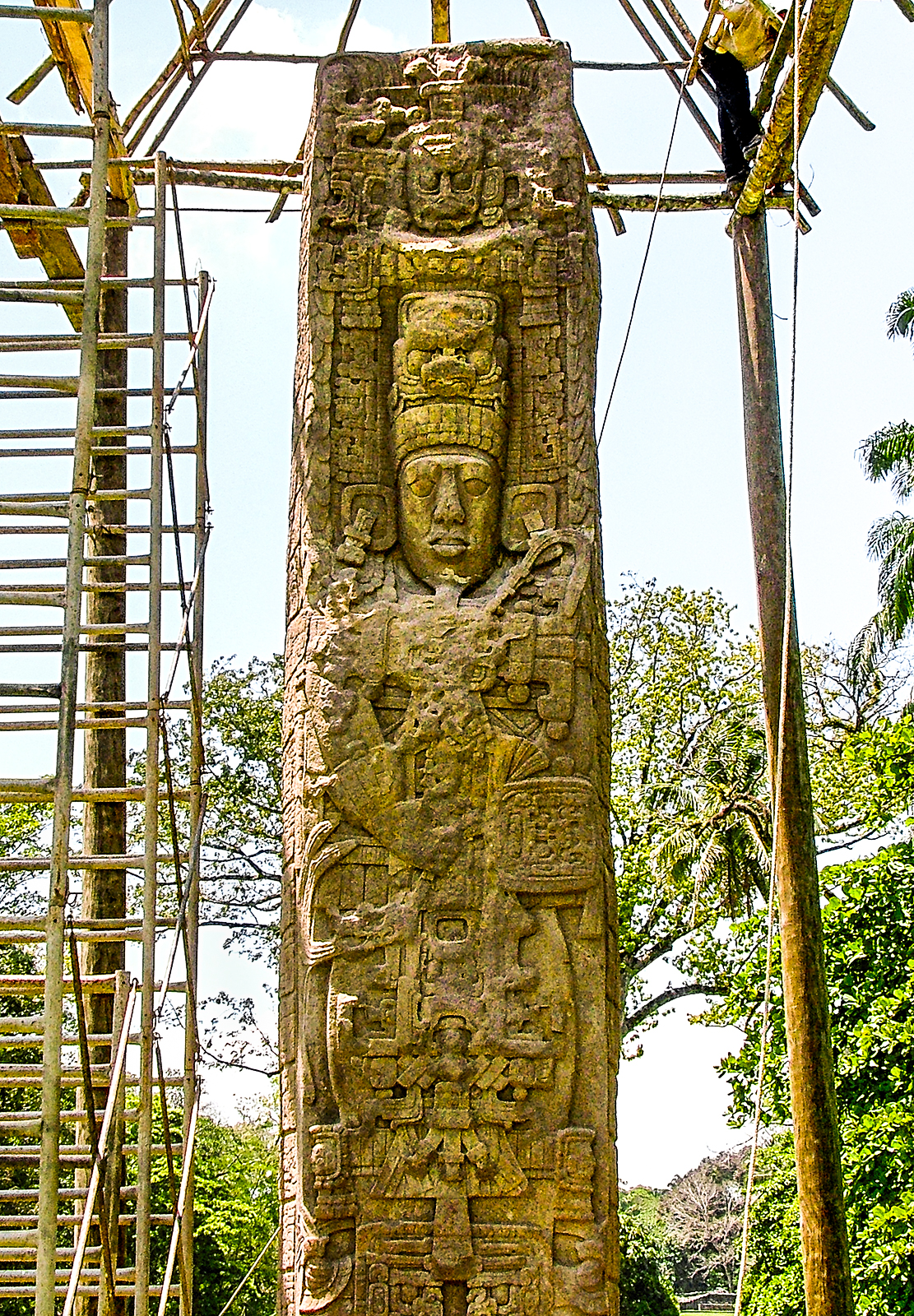
(Stelae) were more than mere representation; they were themselves animate embodiments of the king, extensions of the kingly self that always ‘acted’ to insure the perpetual renewal of time and the cosmos.
David Stuart, Archaeologist
Maya stelae are tall stone monuments, erected in the Classic Period between 100 and 300 AD. Many of them were sculpted in low relief on all four sides with kings, gods, ancestors and hieroglyphs. They were mostly painted red—the color of the life force—but uncarved stelae were also found. It’s speculated that these had been painted with images and glyphs.
Stela E at Quirigua, Honduras (Above)
This is the largest monolithic monument ever erected in the New World. It’s over 24 ft. tall, and below the carving 10 ft. more is sunk in the ground. The worker in the top right corner was one of several men building a new shelter. Stela E was dedicated on January 22, 771 AD to commemorate the completion of the 16th K’atun—a period of 7200 days—and the rise to power of Lord K’ak’ Tiliw Chan Yopaat. On the front and back, he’s shown standing on the earth monster wearing a tall headdress and holding the scepter of divine rulership across his chest. The text on the sides records his accession under the auspices of Waxaklajun Ub’ah K’awiil, the ruler of Copan whom he later tried to best—in part by erecting larger monuments and performing rituals to establish his supernatural identity.
Twelve years after his accession, K’ak’ Tiliw captured and beheaded Uaxaclajuun Ub’aah K’awiil to secure Quirigua’s independence. Then on November 28, 762 he raided Xkuy, a polity under Copan’s control. He captured its sacred palanquin—a litter platform used to ceremonially transport a king, born on the shoulders of slaves—and displayed it in public at Quirigua.
Function
Sculpted stelae recorded ritual moments in time and held them forever, depicting rulers who communed with the gods and divine ancestors to validate their power and authority. Beyond carrying information, they extended the ruler’s gaze and influence. Because there was a sameness between image and subject, sculpted eyes were believed to emanate the life force. So the ruler, apotheosized after death as a divine spirit, could impact the people with his sacred heat and continue to act on their behalf—but only if he and his deeds were remembered. Curiously, the English word is re-member, in a sense to re-establish someone as a member of the community. That’s what remembering did for Maya kings, and it’s why faces proliferate on their monuments, buildings and artifacts.
The stelae functioned within the ritual landscape as surrogate ritual performers. The images of gods portrayed on them were understood as the actual manifestation of those deities, not merely a representation.
David Stuart, Archaeologist
Dedication Ceremonies
Because stela were the embodiments of the ruler, they were given names and treated with great respect and ceremony, helping to define their ritual placement and dedication as everlasting testimony of significant events in the life of the ruler, the community and beyond. Among these rituals was the binding and covering of stelae in cloth shrouds, possibly in imitation of maize husks which could then be ceremonially “shucked” to reveal the substance (kernel) of the event depicted. In the Maya world, everything was perceived to be alive in the first place. Then, once a stone or other object was subjected to a “spirit-entering” ritual, a particular spirit—the ruler in the case of stelae—or a deceased ancestor.
What The Stelae Recorded
These monuments recorded accession to power, lineage birth dates, bloodletting ceremonies, calendar dates and rituals, the dedication of buildings and monuments, marriage alliances, presentation of the heir-apparent, the taking of captives and their sacrifice and war events including the capture of sacred palanquins and god-bundles containing the bones of apotheosized ancestors.
Whether a person was living or dead, commoner or elite, any power they had resided in the spirit that dwelled within. For rulers, spirit power could be acquired by capturing and then sacrificing another elite as an offering to the gods.
Of course we don’t kill people to capture their power today. Instead, we align ourselves and support those with influence. Always, I think it’s a good idea to ask why.
Re-Membering the King in Stone
Excerpt from the novel, Jaguar Wind And Waves (p. 105-109)
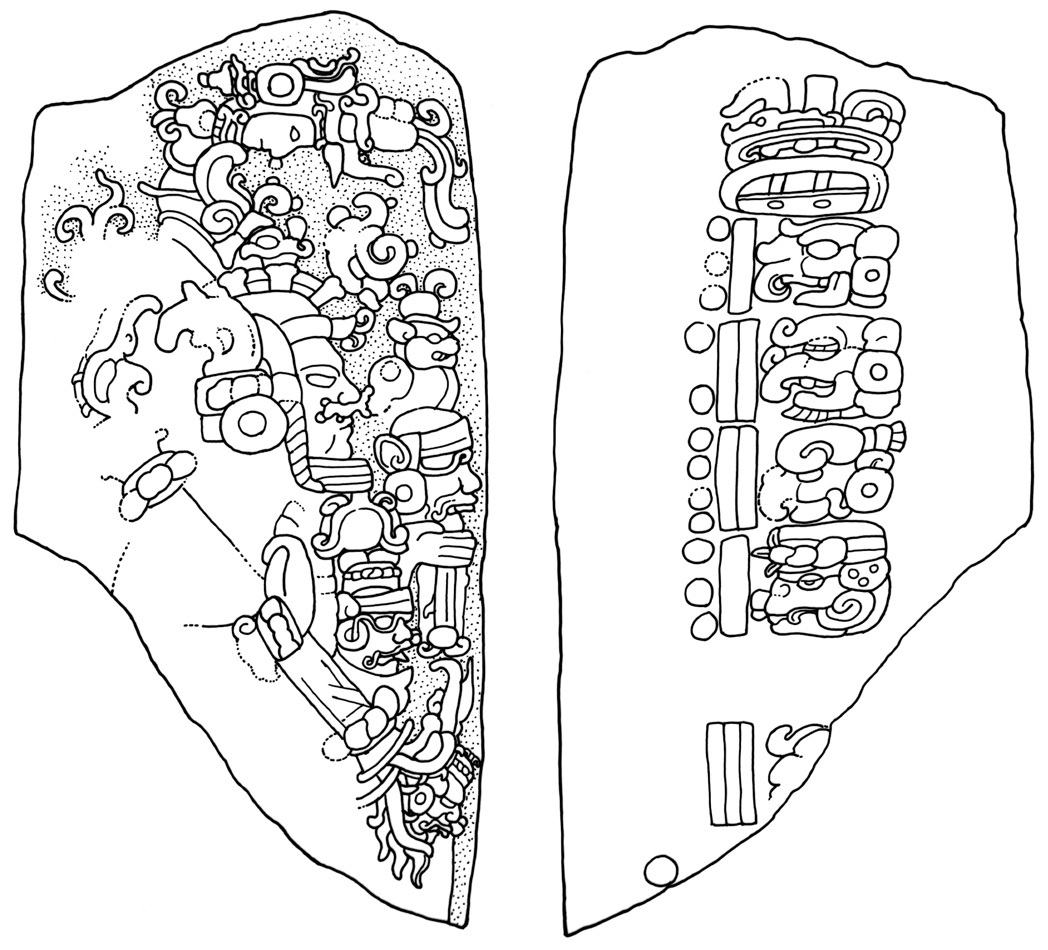
(Jaguar Wind And Waves is largely about a woman’s search to find the stela that her deceased father, the Tikal ruler, had commissioned. In this scene, a holy man is showing the monument to her and her son. They’d been away for many years, so they’re seeing it for the first time. Here, the stela is being described as a whole monument. Later in the story, only a piece of it is found—illustrated as a drawing below).
_________________
I nodded to Father’s monument. “Were you here when he dedicated it?”
“I supervised some of the carving as well, mostly his face and headdress.” We got up and he led me back to the monument where he retrieved a stick with a white feather on the end. Using it as a pointer, he asked Crocodile and Honey a feature in Father’s headdress. “What is this?”
“Jaguar Paw!” Crocodile said immediately. “His name.”
“Well done, young lord.” He pointed the feather to the word-signs at the bottom of the monument. “What about this?”
My son went in close and easily read, “He completed it—the seventeenth k’atun—at Tikal Sky place.”
“Again, well done! I see you are laying well, following in your father’s footsteps. Far Sky gestured and we followed him a few steps into the plaza. He pointed to the top of First True Mountain across the way. Bending slightly, he favored my son and daughter. “Up there is where your grandfather celebrated the completion of that k’atun. Do you know what that means?”
It was Honey’s turn to respond. “The calendar god who carried the burden of the last twenty tunob, completed his journey, set the burden down so the next god could pick it up and carry it forward.”
The old man turned to me with an astonished look. Turning back to Honey, he called her a “bright flower.” We followed him back to Father’s monument. “You know, my lady, your parents were very proud of you. They spoke of you often. Your father said you were making a grand contribution to them and the caah. They missed you greatly.”
Far Sky led us around to the front of the monument. Careful not to block the view of those presenting gifts in front of it, we stood to the side. First Crocodile pointed to the object in my father’s hand, another jaguar paw, long, with the claws extended. “Is that an axe?” he asked.
“With respect young lord, that was his scepter. Your uncle Flint Dancer made it, and I ensouled it for your grandfather. He used it at all the Period Ending rights. That was real pelt, covering a real jaguar bone. It was not painted. The claws were pieces of carved shell.”
“What happened to it? Can I see it?”
“Last I saw, it was in a box in the regalia chamber at the palace. If it is not there, it was probably taken in the attack.”
I asked who sculpted Father’s monument. “He came from Kaminaljuyu, a journey of twenty k’inob. He treated him very well, even had a shelter built at the quarry so he and his men could work through the rains.” He pointed. “The block they cut from the quarry was not much taller, but it was much thicker and broader than what you see here.”
First Crocodile had his head tilted back, looking up. The monument was at least four times his height. Frown-lines creased his smooth forehead. “How did they get it here?”
“That is quite a story. Once it was cut, they wrapped it with green palm fronds, three layers thick. Then they tied on thick matting using cords as thick as your arm.” He explained what a hoist was, telling how the cords worked front and back. “Very slowly, with many strong men, they lowered it onto logs—eight, I believe. Again very slowly, they rolled it on the logs to the causeway and then to here— all in six k’inob.”
“They were actually carved here?” I asked. “Not at the quarry?”
“Always. As for this one, your father wanted the carving to be deeper than the others.” Far Sky pointed to Father’s elbow with the feather. “See here? To make it look like he was standing in front of the temple doorway, they carved his arm so it overlaps the frame—which he said was the doorway to the palace.

Tikal Stela 39
Drawing by Linda Schele © David Schele
“What was the dedication like?”
“Grand, my lady. Colorful. We were up on First True Mountain, the ministers and I wore our jades and quetzal headdresses. The plaza was filled with people. As part of your father’s oratory he repeated what he said when he ascended to the Mat, words that earned him the title, Contribution Lord. You were just a flower—”
“I’m so glad you reminded me of that. I’d almost forgotten. What did he say?”
“I can hear his words as if he spoke them this morning, my lady. He said, ‘I come to the Mat not only to rule, but also to contribute.’”
“He was always talking about how we were privileged to make a grand contribution.”
Far Sky nodded and raised his eyebrows. “I proclaimed that title whenever I introduced him.”
Honey Claw pointed to the figure of a man under Father’s feet. He lay partly on his side but with his sandaled feet rising in back with his head and shoulders high, grasping a bundle to his chest. “Is that one of his captives?” she asked.
I wondered as well. The figure’s artificial beard, the black mask across his eyes, the sacrificial knots on his sandals, and especially the knotted burial cloths around his midsection made it not likely that he was a captive. Far Sky provided the answer. “That is his father, Lord Radiant Hawk Skull—your great-grandfather. His name is also carved on the back.
Crocodile asked, “Why did they show grandfather standing on his back?”“He wanted to be shown rising above him, just as a maize stalk rises from its seeds. Because rulers are the Great Trees of their cities, he honors his father by showing him as both his seed and root. The signs in Lord Skull’s headdress say he held the Mat and celebrated the calendar rounds.”
“What is the bundle he is holding?” Honey asked
“It shows that your great-grandfather was the keeper of a precious bundle, a god-bundle that contained ancestor bones, likely those of the founder of the Paw line.”
First Crocodile went closer to the stone and pointed. “Why is a k’in sign on grandfather’s right anklet? On the other it reads ak’ab.”
He explained the k’in—“day”—sign stands for light and ak’ab—“darkness”—showed that his grandfather had one foot in the sky and the other in the underworld. “He spoke to the gods in both realms.”
____________________________________________________________________________
For a brief description of The Path Of The Jaguar novels: Go to the Home Page—Novels
Links To Amazon.com for paperback books and Kindle Editions
Jaguar Rising: A novel of the Preclassic Maya
Jaguar Wind And Waves: A novel of the Early Classic Maya
Jaguar Sun: The Journey of an Ancient Maya Storyteller
Ancient Maya Solar Observatories
Performance Stages for ritual and community-wide events
 Structure E-VII-sub Uaxactun, Guatemala
By 500 B.C., in the Middle Preclassic Period, there were numerous large architectural assemblages throughout the central lowlands of Guatemala and Mexico. At first, they appeared to function solely as line-of-site markers of the sun’s solstice and equinox turning points. Archaeologists named them “E-Group complexes.”
Although there was great diversity in these structures across time and place, what they had in common was a large rectangular, flat, paved plaza with a square four-sided pyramid aligned to the cardinal directions, situated west of a long narrow platform with small temples that ran north and south.
The first to be investigated in the Maya area was Uaxactun Structure E-VII-sub. Above is how it looked when I visited there in 2000. Although it was severely weathered, early photographs showed there were large deity masks and stairways on all four sides.
We can imagine—as I had when writing Jaguar Rising—a priest-ruler on top of the pyramid before dawn. Adorned with jade and wearing a tall headdress of blue-green quetzal feathers, he and his family, daykeepers and principle courtiers are all there, lit by a brazier, waiting to witness the rising of the Sun god at the corner of the easternmost temple across the plaza. It was an opportunity to verify that both the sacred (tzolkin) and solar (haab) calendars were accurate and congruent, marking the seasons and times for particular rituals and likely agricultural cycles.
After years of investigation at many sites, the consensus is now that, while E-Groups may have originally been built to mark and celebrate the solstice and equinox, their more prolific purpose was to establish a large space with a bonafide sacred center, a theater stage, where kings could perform elaborate calendar rites and other ceremonies.
One of these common to the E-Groups was to celebrate the k’atun (20-year) Period Ending, the day when the current god of that period set his “burden” down and the next god in line picked it up to carry it forward with his particular influences for the next twenty years. Besides lifetime cycles, others notably 13 k’atuns, about 256 years, were also celebrated.
It’s believed that the four-sided pyramid (E-VII-sub at Uaxactun) established the sacred center of an emerging polity or city. It did so by symbolizing the cosmos and the time cycles they held sacred.
- The four sides and stairways have the shape of a cross (+), a symbol for k’in, which is the Maya word for “day” and the glyph for “sun.”
- Aligned to the cardinal points, the pyramid “celebrates” the four directions. In particular, the east-west stairway references the journey of Ajaw K’in the “Lord Sun.” He is born in the east, reaches his highest holy place over the top of the pyramid, descends to his “dying place” in the west to dwell overnight in the Underworld—under the pyramid. In making this journey, Ajaw K’in creates the day. To insure that his journey continued, sacrifices were made on the last day of each period. And they ranged from one day to thousands of years.
- Cosmologically, it was believed that the celestial realm had several layers, or “steps” that Ajaw K’in had to ascend and then descend in his journey. We can imagine then, the king ascending the pyramid steps slowly and thoughtfully.
- As at Uaxactun, E-Group pyramids in other locations often displayed stucco reliefs, masks with cosmological themes. Those on E-VII-sub reference Ajaw K’in, the watery underworld and long-lipped gods representing the earth and sky. According to archaeologist David Freidel, they represent the sun cycle surmounted by Venus. And because the four-sided pyramids usually appear in the middle of open plazas they also represent the center of the universe and the centering point of the four world quarters.
Did E-Groups serve as seasonal observatories or as stages for ceremonial spectacles? More work needs to be done, but it appears that they served both functions. Perhaps even more— at different times and in different places.
E-groups were most widely constructed as Maya society was becoming increasingly stratified, an indication that the ritual they framed ensured both cosmic and political order. By expressing a fundamental cosmological concept on a monumental scale, and as settings for religious and political ritual, E-groups provided an experientially powerful and symbolically meaningful condensation of Maya reality.
James Aimers and Prudence Rice, Anthropologists
Incident at an E-Group, Uaxactun, Guatemala
Excerpt From the novel, Jaguar Rising (pp. 348-349)
We turned north and came to an enormous open and paved, gleaming red plaza where, in the center, gods flanking a pyramid’s steps looked in all four directions. On the eastern side of the pyramid, a stone monument faced a long platform that supported three shrines. Because the plaza itself was one of the holy places Hammerstone told us about, Fishbone pointed to where we could cross, while he, his brothers and Butterfly took a long way around. Judging from the men atop the pyramid wearing quetzal headdresses and dancing to drums, a ritual was in progress.
We met up with the slaves on the other side of the plaza. They were out of breath from running, so White Cord called for a rest. Fishbone took it as an opportunity to tell us why that particular plaza was holy ground. “After the founder built the first shrine in the sacred district,” he said, “he came here, cut a living branch and walked with it until it pointed down—to a little pool of black water. He marked it with stones and then walked east until the branch told him to stop.” Fishbone pointed about fifty strides away to a tall shaft of stone painted red. “That stone marks the eastern ahkantuun. There are three others—white to mark the north, black for west and yellow for south. With the ground so ordered, he made another circuit to mark the trees to be cut. By recognizing the ground as holy, he established it so for the eyes of his followers. They felled the trees to burn limestone and they hardened the ground with mortar between the markers.
When the new plaza was paved and painted red, the founder came again. In the center—where the pool had reflected the canopy—they drilled new fire. And there he offered his blood and the blood of a young woman so the place would forever bring new life. He named it Plaza of Black Water Sky. Nine tunob later his son erected a building over that center, a shrine, and he named it Three Sky Place. Inside he planted a bundle containing the bones of his Father and the female offering. So it was established—the caah of Uaxactun. The shrine has been built over many times since. The bundle that gives life to it is still there.”
Fishbone answered some of our questions and told how the current ruler built the shrine we were seeing, Raised Up Sky—the place where the maize god raised the sky off the water to reveal the land. “Very hot,” Fishbone said. He pointed to three more shrines across the plaza by about two hundred paces. “Now, every solstice, Our Bounty marks the journey of Lord K’in by sighting his face over there.”
White Cord was eager to move on. We all were. The women especially wanted to get settled while there was still some light—and we didn’t know how much farther we would have to go.
____________________________________________________________________________
For a brief description of The Path Of The Jaguar novels: Go to the Home Page—Novels
Links To Amazon.com for paperback books and Kindle Editions
Jaguar Rising: A novel of the Preclassic Maya
Caves: Entrances To The Underworld
Being closer to the gods, they were portals and places of ritual
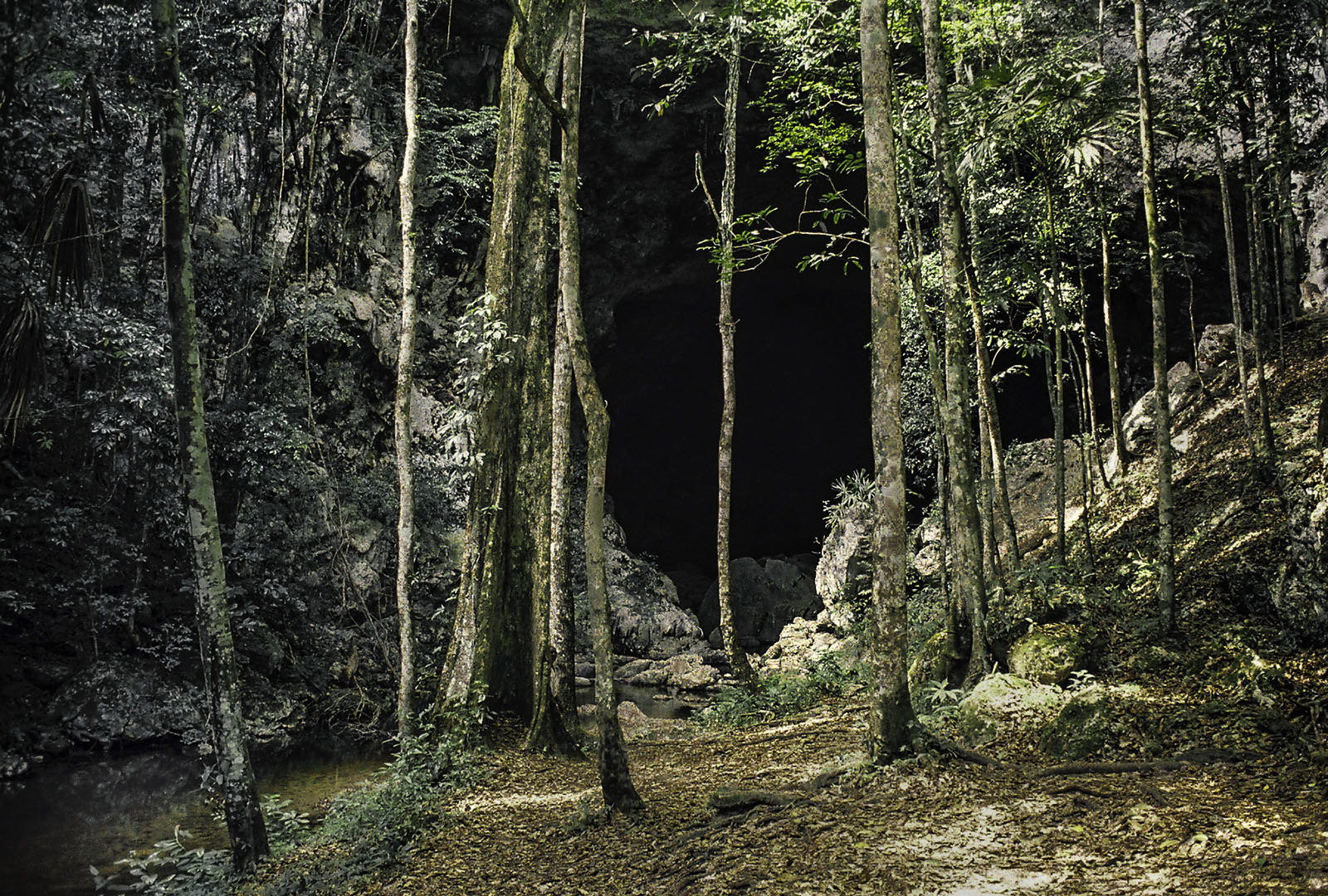 Rio Frio Cave, Belize
Caves, where one descends toward the k’u’x (heart or center) of a mountain, are especially hot places. This is due to their symbolic proximity to the powers unleashed by cosmic convergence at the axis mundi.
Eduard Fisher, Anthropologist
The Yucatan Peninsula is one of the largest limestone shelves in the world. In the north, the bedrock is porous and the landscape relatively flat, so rainwater runs and collects in underground caves. There are no visible rivers here. When a cave ceiling collapses, the result is a sinkhole or cenoté (ts’onot “Sacred Well” in Mayan), that’s usually open to sunlight.
Farther south to Guatemala, especially toward the mountains where thick limestone increasingly mixes with harder volcanic rocks, there are many caves but no cenotés. North and south, caves were a source of water, especially during droughts. Because it was considered zuhuy, “virgin,” it was the preferred libation for use in ceremonies and rituals.
As entrances to Xibalba, the frightful underworld, caves were also used as portals, places of ritual—ecstatic dancing, feasting, sacrificing, places to bury the dead and journey to the otherworlds by ingesting psychoactive drugs.
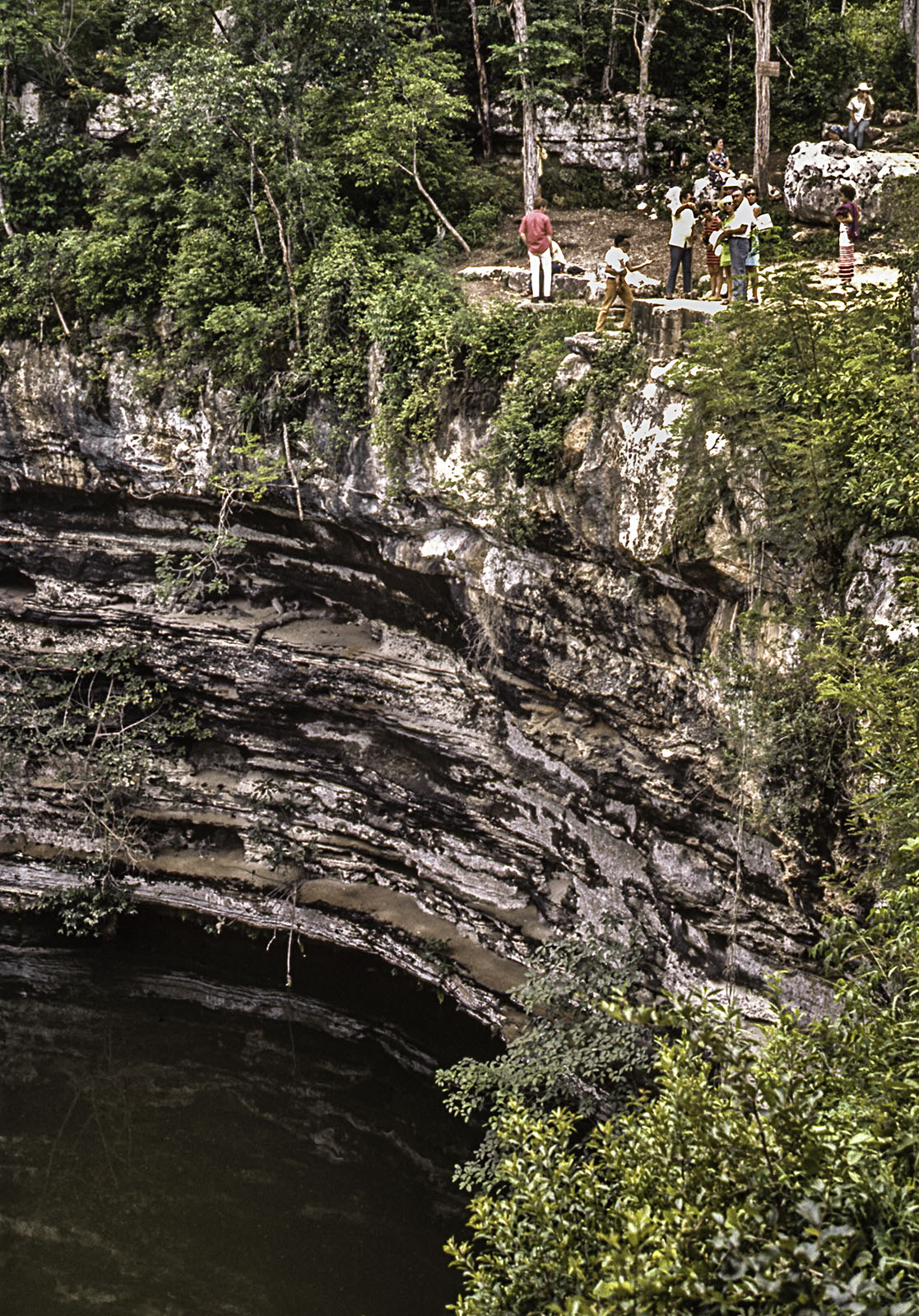
Cenotés were especially favored as places of human sacrifice, the prime example being this one, the “Mouth At The Well Of The Itza” at Chichen Itza in Northern Yucatan. A popular belief was that virgins were the preferred sacrifice here, but archaeologist Guillermo de Anda of the University of Yucatan pieced together the bones of 127 bodies from a nearby sacred cave and found over 80 percent were boys between the ages of 3 and 11. The other 20 percent were mostly adult men.
Caves are heavily represented in Mesoamerica, appearing in Maya art beginning in the Early Preclassic period (1500-900 B.C.). On monuments and painted ceramics, they are depicted as open enclosures wherein are seated gods or rulers. In the Late Classic period, the doorways to temples atop the pyramid mountains in Yucatan were often made to look like the wide-open mouths of deities.
Since art had to communicate cultural information, it was restricted to symbolic imagery whose meanings were shared by members of the Maya community… Individual taste and creative expression had to be subordinated to the imperative of communication. Arbitrary change could not be tolerated… Because of its social function, Maya iconography was of necessity conservative.
Linda Schele, Anthropologist and Mary Miller, Art Historian
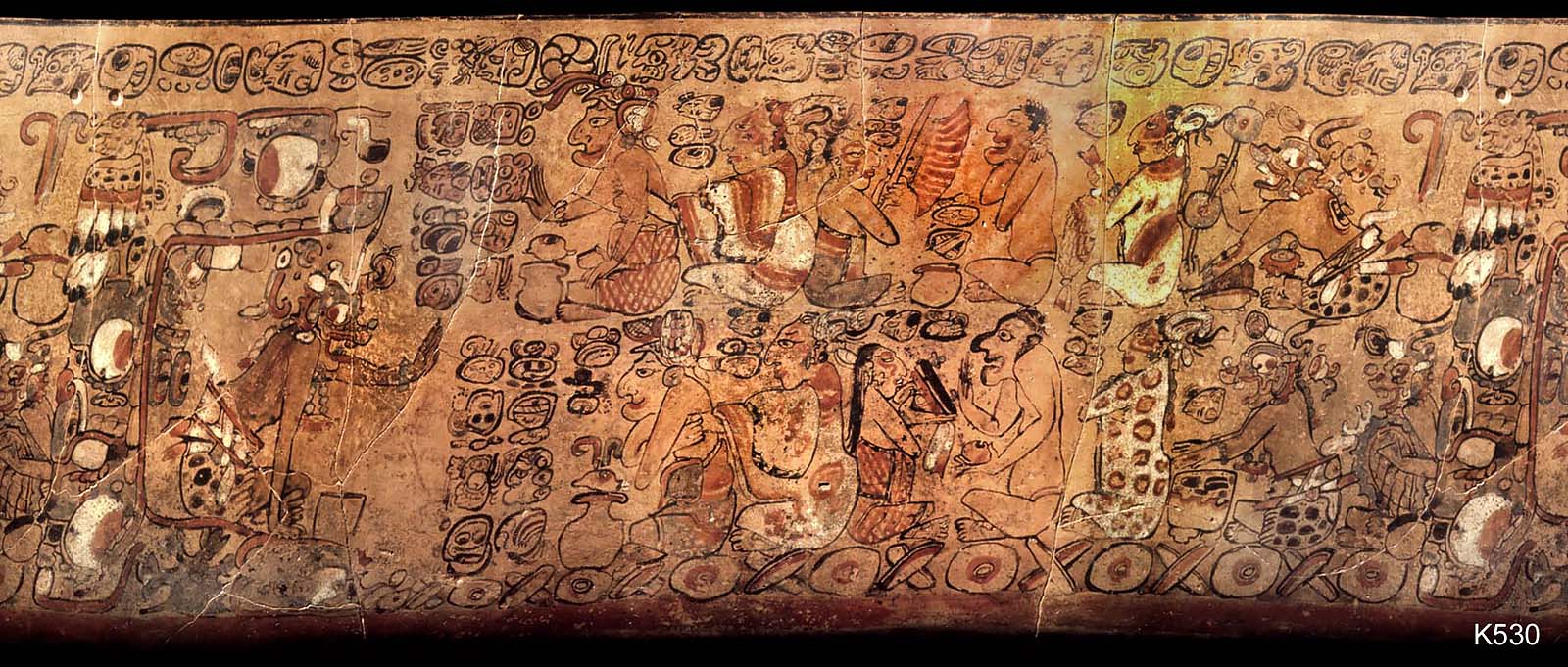
On the left, Chaak, god of thunder, lightning and rain holds court from his mountain cave throne.
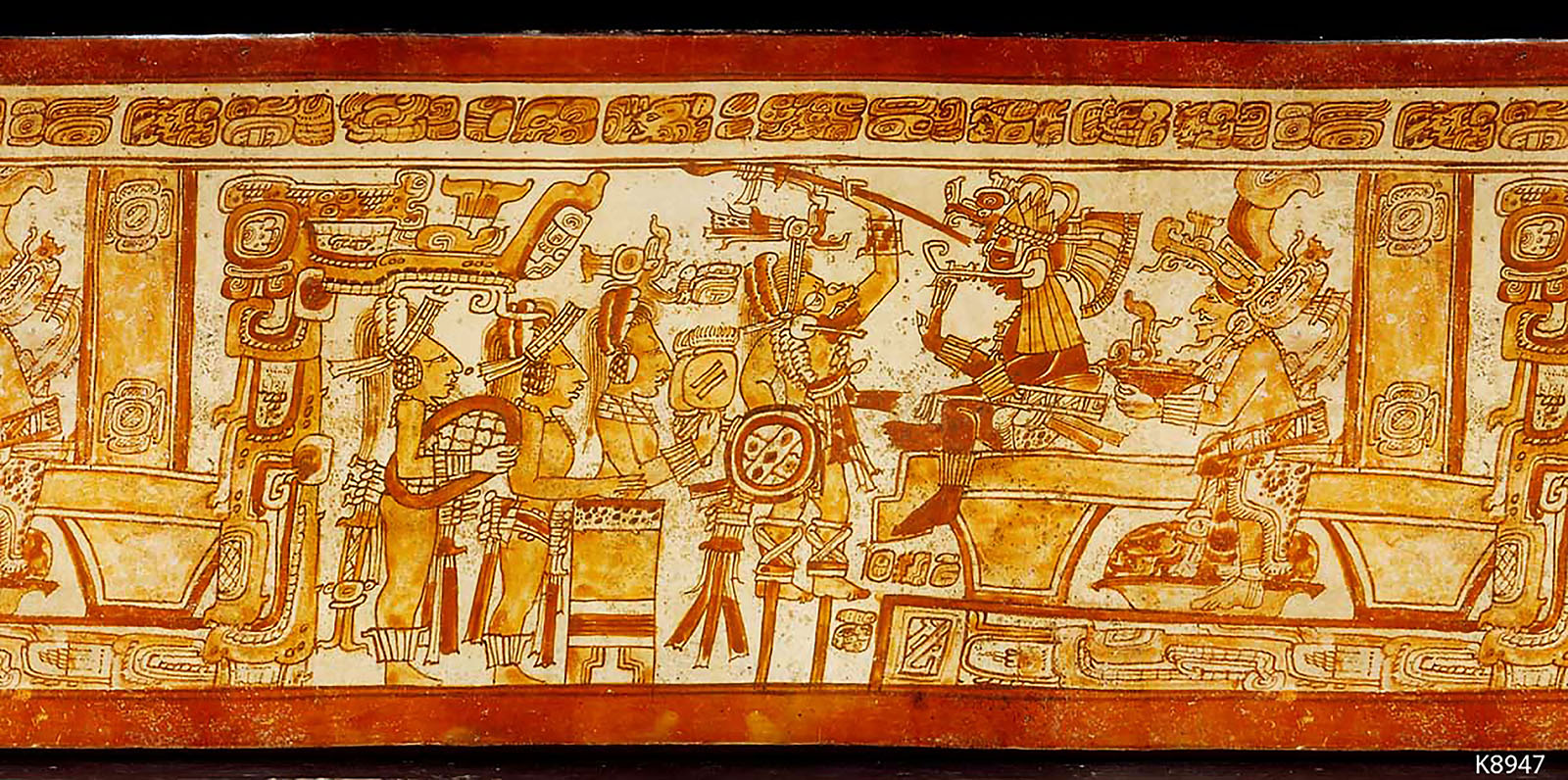
Musicians emerging from a deified cave (left, looking like a great mouth). The ruler is being welcomed on his throne.

Piedras Negras Stela 5
Ruler 3 addresses a courtier from his mountain cave (temple) throne.
(Drawing courtesy of Montgomery, John. The Montgomery Drawings Collection. 2000)
Because everything in the Maya world was perceived to be alive, it’s understandable that mountains (pyramids) and caves (mouths of gods) would be represented in their art and architecture.
The earth itself was conceived as a living sentient being bestowed with the capacity to see, breathe, and embody the concept of ‘personhood.’
Jeremy Coltman, Anthropologist
Approaching The Mouth Of Death (Cave)
Excerpt from the novel, Jaguar Rising (p. 129)
Finally, we came to a place under a dripping canopy where long ago the side of the hill had broken off and fell into an immense black hole. Now, tall trees with lianas hanging into the abyss grew up from the darkness. Others with long roots gripped onto moss- and lichen-covered boulders like talons. A jumble of jagged rocks, vines, rotting and threatening trees like poisonwood and thorny acacia made it impossible to get close enough to see the bottom of the hole but we could hear the drip-water coming off the lianas.
Rising sharply up the hill were the remains of rotting and weed-covered logs that once provided a stairway. Before going up I got a fist-sized stone and threw it into the black hole. Looking at me, White Grandfather poked up his fingers to count while we listened. On the sixth finger we heard a plunk and a fluttering of wings—parrots it turned out. “The Mouth Of Death,” he said.
Inside The Mouth Of Death
Excerpt from the novel, Jaguar Rising (p.131-132)
White Grandfather kept going so I followed him to the back wall where the torches illuminated a hole large enough for a man to fit through, cut in the shape of the painted medallion at White Flower House. This one had a stucco frame around it painted blue. “Portal to the Underworld,” he said. When he poked his torch into the hole the flames came back with a whooshing sound. “The breath of Xibalba,” he said.
Although he’d told me stories about the underworld and the lords of death who dwelled there, it didn’t lessen my fear of being so close to it—or them—especially when he handed me his torch, turned sideways and stepped through the portal. From the other side, he reached back and took the torch so I could come through with my own torch. When he offered his hand I grabbed it and he helped me through. Following him into the darkness with our torches held high, my sandals sunk into soft and very cold dirt. In front of us was the blackest black I’d ever seen. Behind us, the wall above the waist-high portal seemed to be moving. Bats! Winged monsters the size of serving platters, black and huddled together, writhed like palm leaves in a breeze. I shivered and drew my torch closer.
Boulders bigger than a house, some black, some gray, others with dark lines running through them blocked our way, so we went around them and came to a flat where smaller boulders had been arranged to make an altar on a mound. Rocks at the bottom were burnt. Those higher up were encrusted with dried blood and soot. All around there were intact pots and three-legged plates, censers with stacked bird faces, figurines of broad-hipped women, mushroom stones and animal skulls. Dog, deer and tapir were the only ones I could recognize. “The ancestor we told you about, the one who told us it was proper that we were forced out of Mirador? This is where he revealed himself in the smoke.”
White Grandfather led me beyond the altar, to a place where he held out his arm to prevent me from going any farther. Across an immense chasm of darkness in front of us there were jagged shapes and I heard the sound of running water.
My voice echoed when I asked if people went down there—if he had gone down there. He’d not heard of anyone attempting it.
I spoke louder and was about to clap my hands when a flutter of wings told me that wouldn’t be wise. “Too deep,” my teacher said. “Treacherous. Throw a stone.” I picked one up and threw it as far as I could, counting out loud. On the count of “five” we heard a crash followed by a plunk. “The old woman we told you about—our ancestor—said there was a curse put on this place. She said the entrance was behind the hole in the ground where we climbed the wooden steps. Her grandfather spoke of pilgrims coming through there to make offerings to the Earth Lord and the mountain gods, until one of the lords of the underworld became jealous. He shook the ground and vomited up a river of water that flooded the cave. Many people drowned. After that, a black sorcerer put a curse on this place. People stopped coming. After a while, they terminated the caah and left.”
“Did she tell you about the curse—what it was?”
By the light of our torch, the lines on my teacher’s face looked deeper. “To keep people away, the sorcerer called it the Mouth Of Death. He said those who breathe the cold breath of Xibalba would die by drowning.” The expression on my face was easy to read. “No need to worry, grandson. We made proper offerings to the Xibalba Lords. The curse has been lifted.”
“Do you know for certain?”
White Grandfather didn’t reply. Cautiously he led me along the ledge to a place where our torches lit spires coming down from the ceiling and boulders rising out of the abyss. We skirted more boulders and came to a place where there was a tunnel of blackness in the distance, a hole blacker than the surrounding rock. “There, grandson,” he said pointing his torch. “The throat of Xibalba.”
He raised his torch and I raised mine, but they didn’t reveal anything more. “Will the lords be angry that we are here?”
“Few men are privileged to see this, grandson. This is the place where spirits enter when they leave their bodies.”
“The spirits of people? Commoners? They are here? Now?”
“All around. Crossing the river down there and going down the throat.”
I’d been shivering. Now I was trembling. He knew this somehow because he turned back. Stopping again alongside the ledge, he leaned back and threw his torch into the trench. On the count of four it sparked, there was a brief shimmer and it went out.
Outside, the rain had stopped but water dripped from the trees and ran along the ground in finger-like rivulets through the brown leaves. Above the canopy, the clouds were turning pink. It was good to finally stop shivering and breathe some warm air, even if it smelled like rotting wood.
____________________________________________________________________________
For a brief description of The Path Of The Jaguar novels: Go to the Home Page—Novels
Links To Amazon.com for paperback books and Kindle Editions
Jaguar Rising: A novel of the Preclassic Maya
Ancient Maya War And Warriors
Ritualized skirmishes evolved into large scale warfare
 Rollout vase photos courtesy of Justin Kerr
It was the custom among them to pledge what they possessed to each other; upon collection and payment they began to quarrel and attack each other.
Frey Diego de Landa
They never had peace, especially when the cultivation (of milpas) was over, and their greatest desire was to seize important men to sacrifice, because the greater the quality of the victim, the more acceptable their service to the gods.
Alfred Tozzer, Anthropologist
War was the way you got gifts for the gods and kept the universe running.
Linda Schele, Anthropologist
Purpose and Objectives
In the Early period, warfare was practiced as a confrontation between spiritual forces, primarily involving the capture and sacrifice of royal captives. Most valued were captives of high rank. The sacrifice of royal blood was the ultimate gift to the gods. Rather than “battles” between large forces, warfare initially amounted to raids and attacks to take captives. In the inscriptions, what was important was the captive’s name, title and who captured him. A large part of ceremonial warfare amounted to capturing not only a worthy sacrificial victim but also the patron banner of the polity, the ruler’s god-bundle which containing the relics of his deified ancestors, his palanquin and war paraphernalia. All of these sacred items increased the power and prestige of the victor and his lineage. It also brought economic benefits to the community that fueled the emerging elite and contributed to the massing of both commoner and slave labor for construction projects.
According to archaeologist Dr. Arthur Demarest, warfare in the Middle-to-Late Classic was about status and charisma. It helped to define who the royals and elite were and how much power they had with the gods. This was important because knowing who the gods favored provided a means for resolving dynastic succession, it opened trade routes, reinforced the status of elites by providing them with prized possessions such as quetzal, obsidian and jade and it bolstered the victor’s access to tribute labor. Dr. Demerest says, “In this period they did not ruin the enemy’s fields, or take a chance on harming its population because this brought no prestige. The necessary pact between humans and gods was sealed by the bloodletting of rulers.”
Other possible benefits included the acquisition of tribute from subject polities, boundary maintenance, the establishment of warlords which fostered elites and ranking, opportunities for public rituals and spectacles. It legitimized the ruler’s power in dealing with the gods.
Method
Early Maya warfare (Preclassic and first centuries of the Early Classic), pitted the leaders of communities, their noble followers and a reasonable complement of commoner militia against one another on well-known battlefields and on known and planned occasions. I think that Maya warfare had some clear-cut rules of conduct during this early phase of the civilization… The primary tactic was the raid or brief battle aimed at surprise attack and quick defeat rather than total conquest or subjugation.
David Freidel, Archaeologist
Maya artworks show warriors marching behind battle standards—tall poles with large shields attached to the tops, decorated and edged with bright featherwork. (Much larger than those shown here and above). The fighting itself amounted to free-for-alls where the principal lords and warriors, decked out to represent supernatural forces, engaged each other in close-order combat. The sounds of the battlefield came from conchs, rattles, wooden trumpets, wood and turtle carapace drums, whistles and frantic shouting.

Weapons
In the Preclassic period, most polities weren’t large enough to maintain standing armies, so the rulers assembled able-bodied men and boys and armed them with brine-hardened cotton armor, wooden helmets, short stabbing darts, wooden axes with obsidian blades anchored along the sides, spears, axes and slings. It wasn’t until the Postclassic that the Maya used bows and arrows.
Timing
Generally, wars were fought during the dry season, mostly because men would be available after the harvest and before the planting. Aside from agricultural needs, the rainy season with extensive flooding and muddy paths would have made it difficult, at times impossible. The Nacom (chief warlord) presided over an annual festival in the month of Pax (Mid-May). Rites were performed and he was treated as a god and he discussed military matters with the ruler and other members of the court.
A Significant Shift Occurred
According to inscriptions at a variety of sites, on January 31, 378 an emissary from Teotihuacan in Central Mexico called Siyaj K’ahk’ (Born Of Fire) arrived at El Peru/Waka’. On the same day, Tikal’s ruler, Chak Tok Ich’aak (Great Jaguar Claw) “entered the water.” He and his entire lineage were killed and replaced by a new male line drawn from the ruling house at Teotihuacan. Foremost among them was a high nobleman from Teotihuacan named Spearthrower Owl. This event marks the beginning of major changes in Maya society, among them the purpose, strategy and scale of warfare.
The shift was from the modest scale taking of royal captives for sacrifice to the creation and maintenance of city-states through the acquisition of tribute (bounty and labor) from subject polities, the expansion of trade routes, and in the case of the Snake Kings of Calakmul, the establishment of allies to encircle Tikal, their bitter enemy, through marriage alliances. From then on, the “Peten Wars” ratcheted up involving many thousands of warriors in a single battle.
After decades of the Calakmul kings building alliances, on August 3, 695 the current ruler, Yuknoom Yich’aak K’ahk’ (Fiery Claw) led his allies into an enormous battle against the Tikal king, Jasaw Chan K’awiil. In a major twist, Yich’aak K’ahk’ was defeated.
(My novel, Jaguar Wind And Waves, depicts this momentous event).
Postclassic Period (950-1539 AD)
There is evidence of constant warfare in Northern Yucatan among competing city-states throughout these years. The Spaniards reported that Maya armies were large during important campaigns, numbering in the thousands, but they were not maintained very long because they were logistically sustained through temporary appropriations of food and materials from unhappy peasant villagers. And those city-states were then governed by royal families, likely including other elites, rather than individual rulers.
The information provided here derives largely from a collection of scholarly opinions and interpretations. Warfare among the ancient Maya is one of the many cultural practices that changed over time and from place to place. The benefit of collected research and discussion is that it gives us a “taste” of what it was like. In that, we can consider the past as we shape the future.Green-band Raid on Ahktuunal, Guatemala
Excerpt from the novel, Jaguar Rising (p. 35-36 )
Across the plaza at the base of the Great Turtle temple, a similar fate had befallen the Mother of the underlord, members of his council and court including their wives, even his steward. They and the most holy jaguar prophet who speaks to the people on behalf of the ruler and prognosticates for him were also being stripped, bound and tied together. Wherever the green band raiders were from, they apparently needed slaves—probably for construction projects—and a hot-blood for their master’s altar.
Above the chain of captives, the zapote beams of the Holy House of Lord Turtle were engulfed in roaring flames. Tall, red-and-green feather standards on both sides of the doorway burst into flames sending an explosion of sparks into the smoke and fog. With the exception of the residence and the lineage house behind it—where Thunder Flute and Pech were taking cover—all the structures of the central district, the shrines, temples and other structures made of perishable materials, were going up in flames.
The Green Bands brought their looted items to the center of the plaza and dumped them into baskets and onto nets, mats, and blankets, ripping open the tied bundles and spilling out their contents for their leader to inspect. Thunder Flute signed to Pech that he wanted a count of the raiders, including those not in the plaza. In turn, Pech signed an order to an assistant at the back of the Flower House and the message was passed on. Thunder Flute signed again, saying that if the raiders all come together in the plaza, we will attack. If not, they would “target and track” them when they leave. Again, the message was passed. Thunder Flute watched a while longer, then signed again to Pech. Why are they not talking? Pech shook his head and signed back. No one was talking, not a word passed between them.
After parading his prize in front of the warriors, the Owl leader tied the underlord’s neck-cord to the great stone turtle at the base of the temple. The goods being brought into the plaza were more bountiful and precious than Thunder Flute would have thought possible. They overturned a crate filled with ceramic and carved stone turtles packed in dried pine needles. Another contained the hides of deer, peccary, and ocelot. Two of the raiders labored over a large wooden crocodile. With his foot on the back of his neck, he pried out the obsidian eyes with his knife and broke off two rows of shell that served as its teeth. The rest he left, turning his attention to a prickly armadillo goblet offered by a young warrior. When another held out a ceramic censer in the shape of a turtle, he swatted it down and it smashed against the pavement. Thunder Flute noticed that any object carrying the likeness of a turtle—painted, molded, or incised—was either rejected or destroyed.
From a heavy basket, one of the raiders dumped a number of green stones onto a blanket. Thunder Flute wanted to get a closer look so he motioned for Pech to stay where he was while he went around to the back of the residence. Crossing to the council house under the cover of streaming black smoke, he crouched behind a stairway and watched as three of the raiders examined the green stones with their leader. Thunder Flute counted six hand-sized ceremonial celts, at least ten equally long belt danglers, two jade tubes as long as a finger, four jade earflares shaped like flowers, a dark greenstone the size of a fist and scores of jade bead necklaces. When an assistant held one up with the bulbous head of the sun god at the bottom, the leader snatched it out of his hand and stuffed it into his already bulging pouch. From another warrior, he snatched a jade turtle shell the size of a fist, a magnificent piece with three red spots painted on the carapace. With great force, he hurled it down the plaza. Thunder Flute gasped as it hit the pavement and rolled into the smoke.
After dumping some thorny oyster shells, red shell beads, and shell perforators onto a blanket, a warrior with a jagged scar down one arm gathered the ends and slung it onto his back. His brother warriors gathered up the other goods and the leader followed, all the while looking to see if there would be any resistance. There was none. Along the way, he stepped onto the back of a fallen Ahktuunal guard and struck a victory pose with his axe held high. Several of his men imitated the gesture, and together they howled like coyotes.
Thunder Flute took advantage of the distraction. He ran behind the retaining wall to where Pech was watching. Beside him, an assistant pointed to the temple of the Great Turtle. Through the smoke, high on the third terrace and hiding behind a fallen censer stand, a scout was signing: god bundle burned—six guards down. Warriors gone.
Gather their weapons, Thunder Flute signed. Return to the canoes. He whispered in Pech’s ear, “I want a man on the far side of the council house—to see where they will go. The leader threw a jade turtle down the plaza, a big one. I want it.”
____________________________________________________________________________
For a brief description of The Path Of The Jaguar novels: Go to the Home Page—Novels
Links To Amazon.com for paperback books and Kindle Editions
Jaguar Rising: A novel of the Preclassic Maya
Jaguar Wind And Waves: A novel of the Early Classic Maya
Jaguar Sun: The Journey of an Ancient Maya Storyteller
The Ancient Maya Ball Game
Where the story of creation was repeated and celebrated

Ball Court: Copan, Honduras

Scholars believe that in earlier Maya times, the contest was a ritual that represented the fight of the opposing and forces of the universe—life-death, Sun-Moon, day-night, light-darkness—in order to insure balance, continuity and fertility. Some say it was a metaphor for the movements of heavenly bodies, the ball representing the journey of the Sun god passing in and out of the underworld. Because some courts have stone rings on the walls for the ball to pass through, other say it was about the Earth swallowing the sun where the losers would be sacrificed as an offering to the Sun god to insure his rebirth the next day.

In 2008 my guide on the right told how the ball game bore a strong relation to the Popol Vuh account of creation. I had my audio recorder going. The following is an abbreviated version of his account.
The ball game was a ceremony of creation. The Hero Twins, Hun Hunahpu and Xbalanque, danced here and woke up the Lords of the Underworld. The owls came and invited them to go to the Underworld. There, they defeated the bad forces and saved their father who was reborn, apotheosized as Orion in the sky. Hunahpu, Hun Hunapu’s son, was reborn and became the Sun. Xbalanque became Venus. And Xmucane, their grandmother, became the Moon. This is how the Maya universe was created.
The shaman, or specialized dancers of the ball game, were men who prepared their whole lives to fight against the bad forces—storms, earthquakes, epidemics, drought—all of which came from the Underworld. The ball represented the movement of the creators. Everything was alive. The ball bouncing up and down represented sunrise and sunset. And when it hit one of the macaw heads placed in the center and the ends of the risers, it signaled the defeat of the bad forces.

Vucub Kakich, the Principle Bird Deity, oversees the ball court from the riser. The central macaw head is below, a front view beneath a corbled vaulted hallway.
Continuing the story, Hunahpu tried to defeat Vucub Kakich—the vein god who fancied himself more powerful than the Sun—using a blowgun. Repeating that event here in the ball court, the players tried to hit a macaw head with the ball to defeat this great bird. He’s shown in the celestial realm, on the highest level of the court. When the ball hit the floor in the alleyway, it amounted to the Hero Twins knocking on the door of the underworld, a demonstration that they had the courage and power to wake the forces of evil to fight against them. When a king engaged in this enactment of good versus evil it was an opportunity for him to assume the persona of a Hero Twin and defeat death. The ancients didn’t look for winners or losers. They wanted a hero, somebody who had the courage to fight against the forces of evil.
Sacrificial Rituals
According to the inscriptions, losers were decapitated, their heads symbolic of the “sacred sun” ball. At Yaxchilan and possibly other places, the heads of war captives were thrown from the top of a long stairway, emulating the rolling of the ball. This was briefly depicted in Mel Gibson’s 2010 movie, Apocalypto.
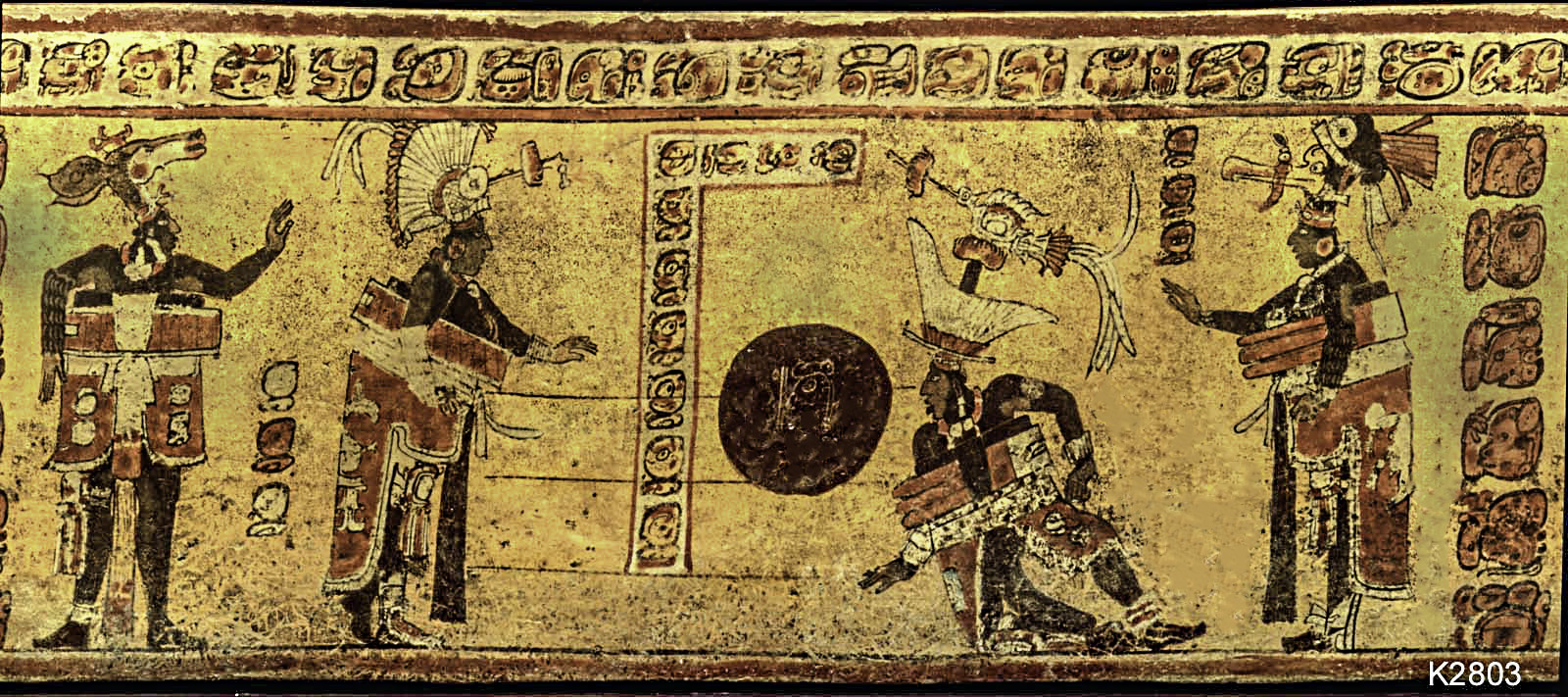
Elites engage in a ball game ritual. The ball (with a glyph inside) is about to connect with the king’s hip and chest deflectors. The horizontal lines are the ball court steps. Black body paint was often worn by warriors. Here, they are warring against the forces of evil. On the murals at Bonampak, bird headdresses were worn by winners; deer was worn by the losers. (Rollout photo courtesy of Justin Kerr)
Royal Players
It was a badge of honor for royalty to be good ball players. It’s reported that after great battles were waged, prisoners were brought back to the city of the victor where they were starved and dragged onto the ball court for a match. With depleted strength, they lost the game—and their heads—but shedding their blood on the court meant dying with honor. One writer suggests “The highest goal of Classic kings seems to have been to capture the ruler of a rival city in battle, torture and humiliate him (sometimes for years), then, following a ball game decapitate him.
Another says, “To capture an enemy and then let him be defeated in the ball game was to let him die with dignity. Royals became apotheosized—made divine—in this way. And the winner captured the loser’s power (the head was seen as the center of power).”
The Ball Itself
Ol, the Maya word for “rubber” is also the word for “heart” and “motion.” The ball was referred to as cahuchu “weaping wood” because of it was made from the sap of a tree. Inscriptions give the size of the ball, for instance, a circumference of “twelve-handspans” is indicated on a vase from Motul de San Jose in Belize. That meant it could be 12-18 inches in diameter. Spaniards also reported that the balls weighed six to eight pounds. And the juice of Morning Glory vine s were added to give them more bounce.
Later on, The Ritual Was Played As A Game
The object was to keep the ball in the air without touching it with the hands. Only shoulders, forearms, hips and knees could contact the ball. A goal was scored when the ball bounced off the wall and hit one of the stone markers—or a macaw head at Copan. If it ever went through a ring mounted on the walls—as at Chichen Itza—the person who did it won automatically. Scoring was based on faults: touching the ball with head or hands or feet; failing to connect with the ball; sending the ball out of the court. After one bounce, the other player got to serve the ball. If it bounced twice the other person scored. The first person to reach thirteen points won.
The Mesoamerican ball game provided a formalized context and ritual wherein the mystery of death and the mythology of creation could be repeated and celebrated with an eye to the future. As a contest between the forces of good and evil, arranged so the good—perceived as the Sun god—would prevail and the world would not end.
Game Played Between Brothers To Determine The Heir To The Throne
Excerpt from the novel, Jaguar Rising (p. 411)
(In the following, Fire Eyes Jaguar, the protagonist, surrenders his body to Lord K’in, the Sun god by taking a hallucinogenic drug and dawning a Sun god helmet. His brother, Flint Axe Macaw, does likewise wearing the helmet of Chaak Ek’, god of Venus. In this particular game, the winner (god representative) who has thirteen human skulls set on the wall—each representing a point—at the end of the game will replace their father as the Lord of Kaminaljuyu. “Dark Sun” is a reference to the ball).
AS HAD BEEN ESTABLISHED IN THE SKY—CHAAK EK’, GOD OF the morning star preceded Lord K’in, the sun god, along the White Flower Way— my brother danced onto the alleyway making quick turns, swinging his invisible axe and pounding the ground with his feet to taunt the lords of the Underworld. I waited for him to make a full circle, then followed behind him. Since Lord K’in was believed to prowl at night as a jaguar, I danced him as Red Paw had in Father’s courtyard the night after my presentation. I strutted, crouched and eyed Chaak Ek’ as if he were my prey.
The veil of brightness over my eyes burned even more because of the hundreds of torches that surrounded us. I poked my fingers through the eyeholes to rub them, but it didn’t remove the veil or ease the burning. Watching my brother dance, I had the feeling that I’d done this before.
Lightning flashed and a thunderclap shook the ground. I’d never heard anything so loud, not even in the House of Obsidian. I and everyone I could see had crouched. Just as suddenly, the light tapping on my helmet turned to pounding rain which quickly seeped into the eye- and mouth-holes. Oddly, the padding in my helmet was colder than the rain on my shoulders. My brother danced as if he welcomed it, running the alleyway like a freed deer, turning and leaping over the markers and darting back and forth to the end zones.
Feeling the power of the cheering, I danced jaguar staring, sprinting and pouncing but missing his prey. There came another bright flash and three breaths later a thunderclap so loud I yelled into my helmet. “Ayaahh! Huracan! First Lightning! Here we are! Do you see?” I crouched and stayed still. “Great Thunderbolt! Is this your doing? I said I would have the head of the Iguana. If Lord Tapir and the Iguana are the cloud of death, I will be the destroyer, the cloud breaker. But enough of this rain! Enough of this dancing. Father wants a ball game. Let us begin.”
Chaak Ek’ took a position on the northern side of the center marker, facing the eastern end zone with his hands on his knees. Facing him ten paces away, I took my stance. Keeper of the Ball went to the eastern marker where he held Dark Sun low, between his knees with both hands. To distract me from the pounding on my helmet, I kept repeating out loud, “Thirteen skulls, thirteen skulls, thirteen…” With my eyes trained on the menacing face of Chaak Ek’, words came into my head that shocked me. “Flint Axe, you are standing in the way of my destiny.” It was then that I knew—Lord K’in had entered my body, taken my place. I would never have had such a thought. Where Fire Eyes Jaguar had gone I did not know.
AS HAD HAPPENED IN THE MAKING OF THE WORLD ON the first day, the game began with the rising of Dark Sun from the east. Ballplayers referred to the opening volley as “Comes the dawning.” Chaak Ek’ got under the ball and deflected it off his hip. It bounced toward me. I turned and connected hard with my hip and the ball went out of his reach. It bounced once and rolled across the alleyway. I let out a yelp when the keeper of the count set a white skull on the northern wall.
As the keeper took his stance at the eastern end zone, the rain let up. He didn’t squat very low this time. The ball fell short. I deflected it off my hip and it went low. After one bounce Chaak Ek’ slid under it and connected on the underside of both wrists. I ran and connected high on my hip protector. The impact sent a sharp pain through my ribs, reminding me of Gourd Scorpion and the injury sustained in the Nine Step court. The ball bounced twice before Chaak Ek’ could get to it, so I gained another skull.
On the next round, the onlookers applauded our keeping the ball in play, back and forth without any misses. I tried to keep it high. Chaak Ek’ kept it low, apparently to take advantage of my injured leg. He made an elbow deflection and when the ball hit the ground it rolled. That put a yellow skull on his wall.
Chaak Ek’ connected with a stylish combination of a lunge and hip deflection. I returned it the same way and the onlookers applauded—even more, when he deflected with his knee and the ball rolled between my legs. Another skull for him.
The keeper squatted and turned his back to us. Chaak Ek’ went back and I stayed close. The ball fell short and I connected with both wrists. Chaak Ek’ got under it and butted the ball with his helmet, sending me running. I wasn’t even close.
Spectators in the end zone behind Chaak Ek’ were all a blur. The ball came to him and he connected with a stylish standing twist. I returned it off my hip. He deflected it back and we closed the gap between us. He turned and did a front deflection. On my return, he jumped back and connected with his knee-protector. I dove but missed.
I scored on the next round. Chaak Ek’ took the following two. He was managing better than me to either send the ball where I wasn’t or to hit it so forcefully I couldn’t get to it in time to connect. He was ahead of me by three skulls, but I was learning fast. By playing closer—which he seemed to want—and trusting the nubs on my sandals, I defeated him twice.
Hoping to slow me down, Chaak Ek’ kept deflecting the ball toward the center where the rain was pooling. I wasn’t slipping, so I played close to the marker and kept him on the sides. On a quick turn, he slipped and fell and the ball ran along the northern platform. When he slipped and missed again, I counted the skulls—Lord K’in seven, Chaak Ek’ six.
____________________________________________________________________________
For a brief description of The Path Of The Jaguar novels: Go to the Home Page—Novels
Links To Amazon.com for paperback books and Kindle Editions
Jaguar Rising: A novel of the Preclassic Maya
Jaguar Wind And Waves: A novel of the Early Classic Maya
Jaguar Sun: The Journey of an Ancient Maya Storyteller
Ancient Maya Clothing
What you wore was a sign of who you were and where you lived

Whether intended or not, clothing communicates. For example, an apron in modern society can signal that the wearer is a chef or manual laborer. It can also symbolize the wearer’s beliefs and values, as when an apron is worn by a Rabbi. The elite Maya of the Classic Period went to extremes in the latter category, investing many items of clothing with meaning.
While commoner garments were simply intended to beautify or eroticize the body, those depicted in art—ceremonial regalia, jewelry and body manipulation such as scarification, tattooing, piercing, teeth filing and cranial modification, were rich with meanings that referenced and celebrated their myths and ideology. In the Early Preclassic period, symbols were largely based on ancestor veneration. In the Classic Period, belief systems evolved to where the emphasis was on stories of creation, gods and apotheosized rulers—those who’d died and became deified.
With regard to body coverings, the materials at hand were mostly plant fibers including cotton, kapok, yucca and agave, which contains henequen and maguey fibers. Animal products such as duck and goose feathers, deer hides and feline furs were incorporated as well. A thousand years later, in Aztec Mexico, only the king could wear fine mantles of cotton. So it’s likely that cotton was also reserved for Maya elites. With regard to commoners and slaves, very little is known about their coverings, except they mostly consisted of maguey fibers. Soaking and cooking the leaves made them tender enough to scrape and shape into long soft threads that were dried in the sun and then woven into fabrics.

The principle device for weaving raw fiber into cloth was the backstrap loom, similar to the ones used today. Since the looms are not very wide, several widths of woven cloth were sewn together to create square or rectangular shaped garments. These were fitted in place with a belt or fabric tie. Weaving lent itself to the making of geometric shapes and patterns. Below, the patterns woven into the woman’s huipil and the ruler’s cape symbolize the four cardinal directions.
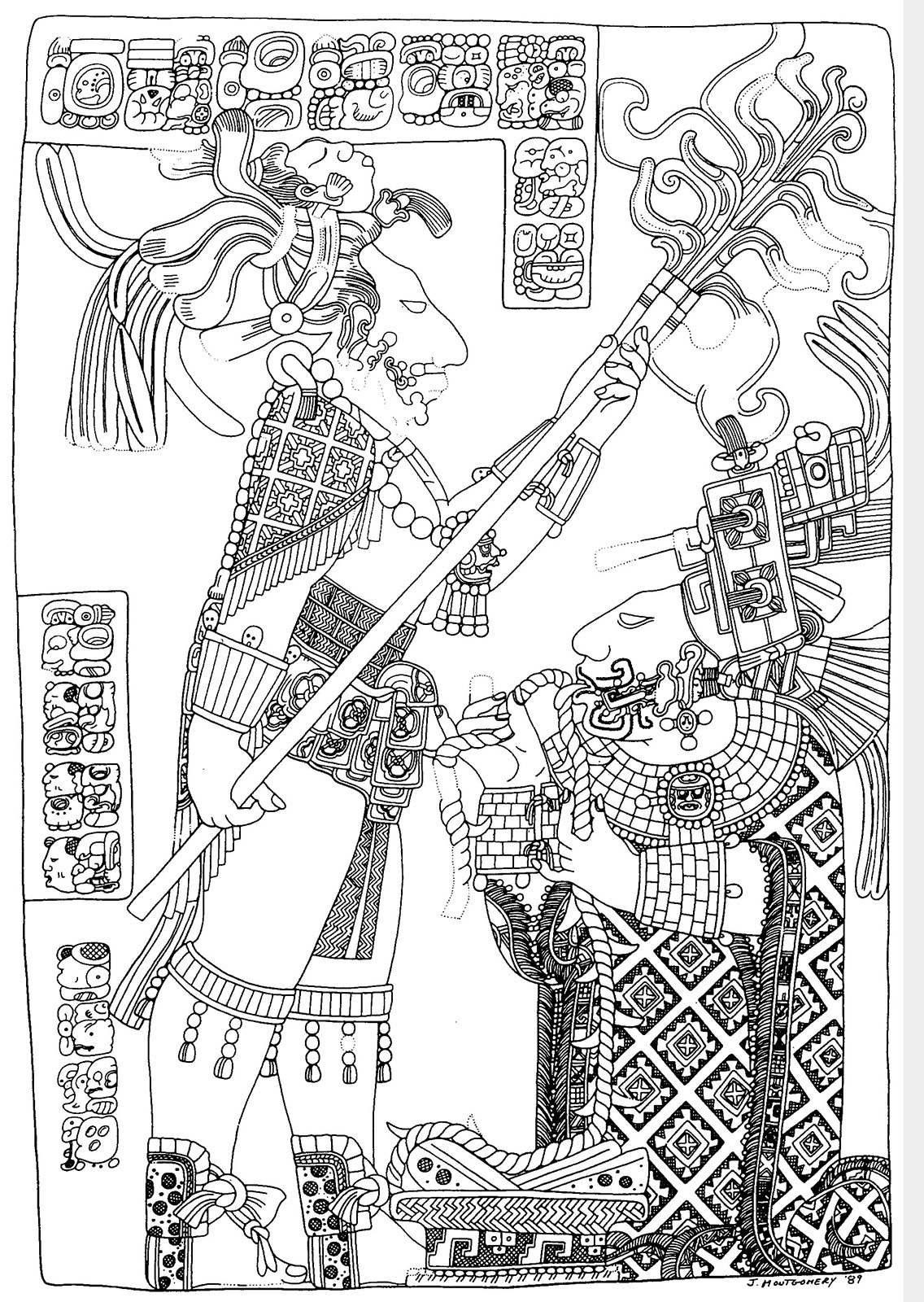
Dated approximately 709 AD, Shield Jaguar, Lord of Yaxchilan, holds a torch over his wife, Lady Xoc, who performs a bloodletting sacrifice by pulling a barbed cord through her tongue. Her huipil appears to be embroidered and trimmed with fringe and pearls, and the pectoral on her beaded collar—likely made of shell or jade plaques—depicts the sun god. The object at their feet is an offering bowl containing blood-splattered cloths to be burned along with copal incense.
Although insect, vegetable and mineral dyes were traded extensively in the Classic Period, the archaeological record indicates a strong preference for painting on cloth—clothing—using stamps and brushes. Embroidered stitching, which was an easy and quick way to embellish a woven garment with color and designs is also in evidence, worn by elite women. Though scholars are still debating gender roles and responsibilities, weaving tended to be the domain of women, and farming the responsibility of men. Attire for both men and women varied depending on the individual, status, location and time period.

In this unprovenanced panel in the Cleveland Museum of Art dated 795 AD, a royal woman holds an effigy, a “God K” or “K’awiil scepter.” The kings who displayed it proclaimed themselves masters of the “Vision Serpent,” which conferred upon him the ability to negotiate with the gods. Here, the woman is wearing a huipil, a long outer garment that covered the shoulders, chest and hips. Those worn by commoners were likely plain with little or no embellishment. Huipils of elite and royal women usually contained symbols. The four quatrefoil designs on this figure represent “portals” to the otherworlds. Also evident here is an undergarment. In hot climates, women of all ranks more often wore a sarong, a long garment tied under the arms that could more or less conceal the legs (See the figurine on the right in the first photo).
The figurine in the center wears a typical loincloth. Men of all ranks wore them, some with shorter or longer hanging ends, a long or short skirt, a short waist-length jacket and in some instances the elites wore a short cape. Because males depicted on monuments are sometimes shown wearing long skirts as seen on Copan Stela H (Schele #1011), it took the decipherment of inscriptions for scholars to realize they were men. The length of a skirt alone is no longer considered an indication of gender.
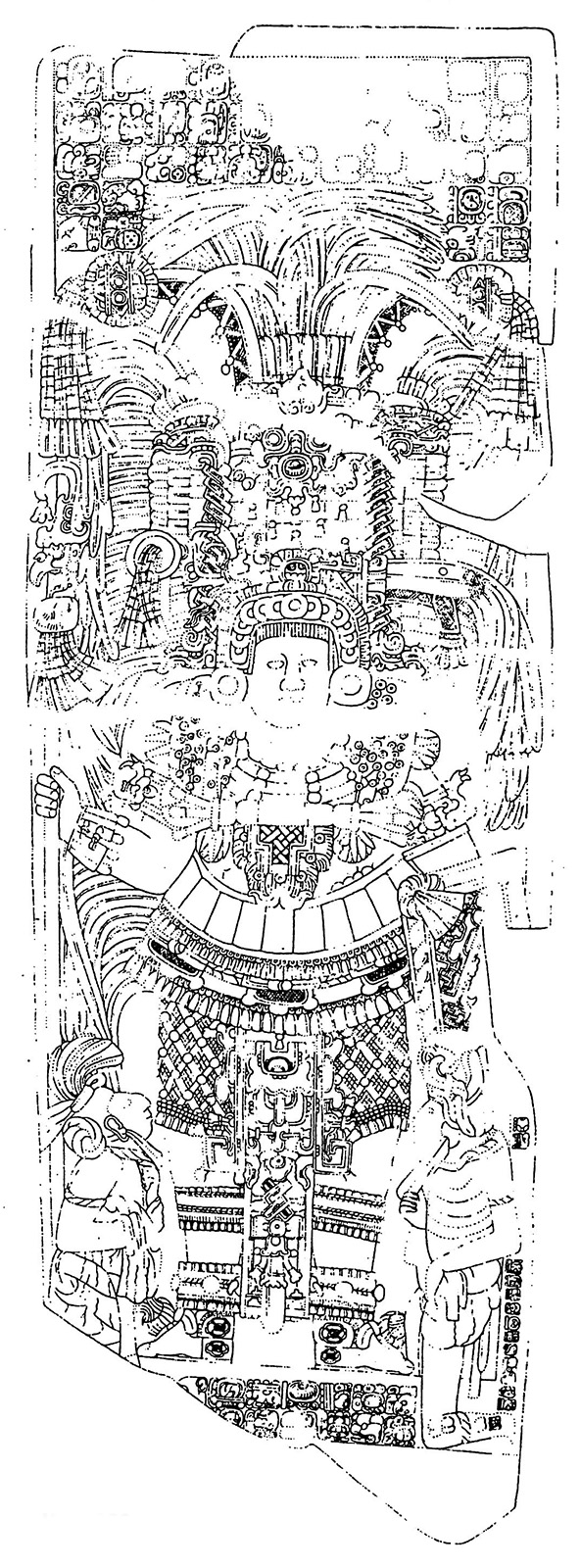 Piedras Negras Stela 8
The jade-beaded latticework on a cape or skirt, seen here, can be long or short, worn by a man or woman. Always, it signifies maize god. Commonly, a Spondylus (spiny oyster) shell hangs from the belt with the face of a fish on it, a mythological shark the maize god defeated in the Underworld. It was worn as a sign of victory. That beaded garments are worn by both men and women, anthropologist Karen Bassie-Sweet sees them as an example of gender “complementarity.” Maize plants, and therefore the maize god, had both male and female elements.
Lavish clothing, regalia and costumes signified elite status. Fabric embellishments could include jaguar pelts, bird feathers, flowers and wood, leather or thinly painted ceramic constructions that represented fish, waterlilies, the heads of gods, underworld monsters and other mythical or symbolic creatures. At the other end of the spectrum, because nudity signaled disgrace, captives wore nothing other than strands of paper in their earlobes, another symbol of disgrace.
The elaboration of footwear was another element that distinguished the elite from commoners. Slaves went barefoot. Most everyone else wore sandals. I notice, however, the royal woman wearing the decorated huipil in the above drawing is barefoot. Most unusual. Kings always wore high-backed and probably animal hide sandals, often embellished with feathers and jewels containing symbols. On Yaxchilan Lintel 24 (above), the king’s sandals display black circles with hashing that represented little jaguar pelts.
Reference to Backstrap Looms
Excerpts from the novel, Jaguar Rising (pgs. 31 and 223)
Thunder Flute interrupted. “Of all the places we trade, none offers better embroidery. On the last trip, the exchange was better here than at Kaminaljuyu. Lord Macaw gives his son an advantage—and we take it.”
“All the women weave,” Pech said. “You will see—as soon as a flower can talk she will be sitting beside her mother at the loom. Unfortunately for us, the women at court do the best work. Most of it never reaches the marketplace. If I or one of the assistants is not nearby, do your best. Better to acquire fine work than not. You will know it when you see it.”
The steward led us across the plaza to a large house that sat on a high, white-painted platform with scarlet macaws in flight painted on both sides of a broad stairway. He told us his master was holding council, but he went in anyway to let him know that we were there. While we waited, Standing Rock led us to the corner of the platform that overlooked a patio where women were weaving with back-strap looms. Thunder Flute spoke from behind me and close to my ear. “Ladies of the court. They weave from dreams. The cotton is the finest you will see anywhere.” Voices behind us were three men in red robes coming through the doorway. They nodded to us and went down the steps.
Ruler Wears The Beaded Maize God Skirt
Excerpt from the novel, Jaguar Rising (p. 360)
Moments later, Lord Cormorant, lavishly attired in quetzal feathers and a jade-studded skirt, came down the steps with his jaguar prophet. Stopping on the first terrace, the prophet replaced the ruler’s k’atun helmet with the sak huunal. The prophet raised his arms and the drums called us to order. I judged there to be near to six hundred people there, all huddled in blankets. After several moments of silence, looking to the sky with arms outstretched, he gave the prophecy for the next twenty years.
A Gift Of Elite Sandals To A Merchant
Excerpt from the novel, Jaguar Rising (p. 315)
BLOOD SHARK HAD THE SERVANTS MOVE MY ITEMS TO THE side and he gestured for me to follow. Blue Skin stepped down from the dais and Yellow Stone admitted other servants with bundles intended for Thunder Flute as he came over. “Thunder Flute Rabbit,” the lord said gesturing, “Your compensations for teaching Blue Skin and our first spears the ways of the Tollan warriors.”
The largest bundle contained a tapir pelt and seven embroidered mantles, beautiful pieces for Thunder Flute’s wearing. Next, came an assortment of colorful feathers which Blue Skin named: turkey, eagle, toucan, duck and owl. The great white heron feathers were especially beautiful, but it was the owl feathers that Thunder Flute chose to touch with two fingers and express his gratitude. From a third bundle, he held up a pair of high-backed sandals. “The bottoms and straps are crocodile,” Blue Skin said. “The backs are doe-hide. Very soft.” Owl faces were burnt into both backs. When he put them on and walked, Thunder Flute’s face lit up like never before.
“For when you become raised and titled,” Lord Tapir explained. “The burner tried to match the tattoo on your chest.”
* All drawings courtesy of The Montgomery Drawings Collection, 2000. FAMSI Resources.
____________________________________________________________________________
For a brief description of The Path Of The Jaguar novels: Go to the Home Page—Novels
Links To Amazon.com for paperback books and Kindle Editions—
Jaguar Rising: A novel of the Preclassic Maya
 Ancient Maya Cultural Traits